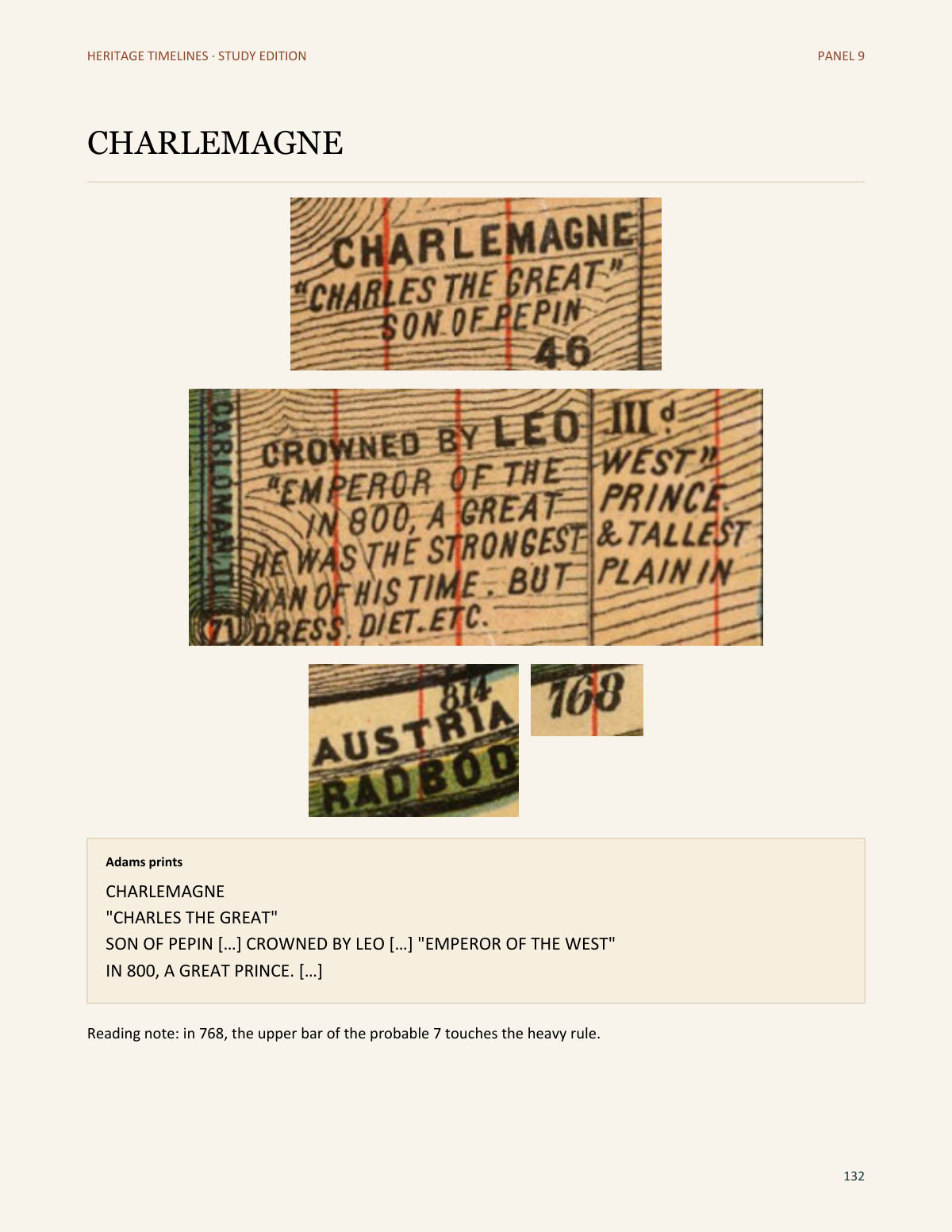
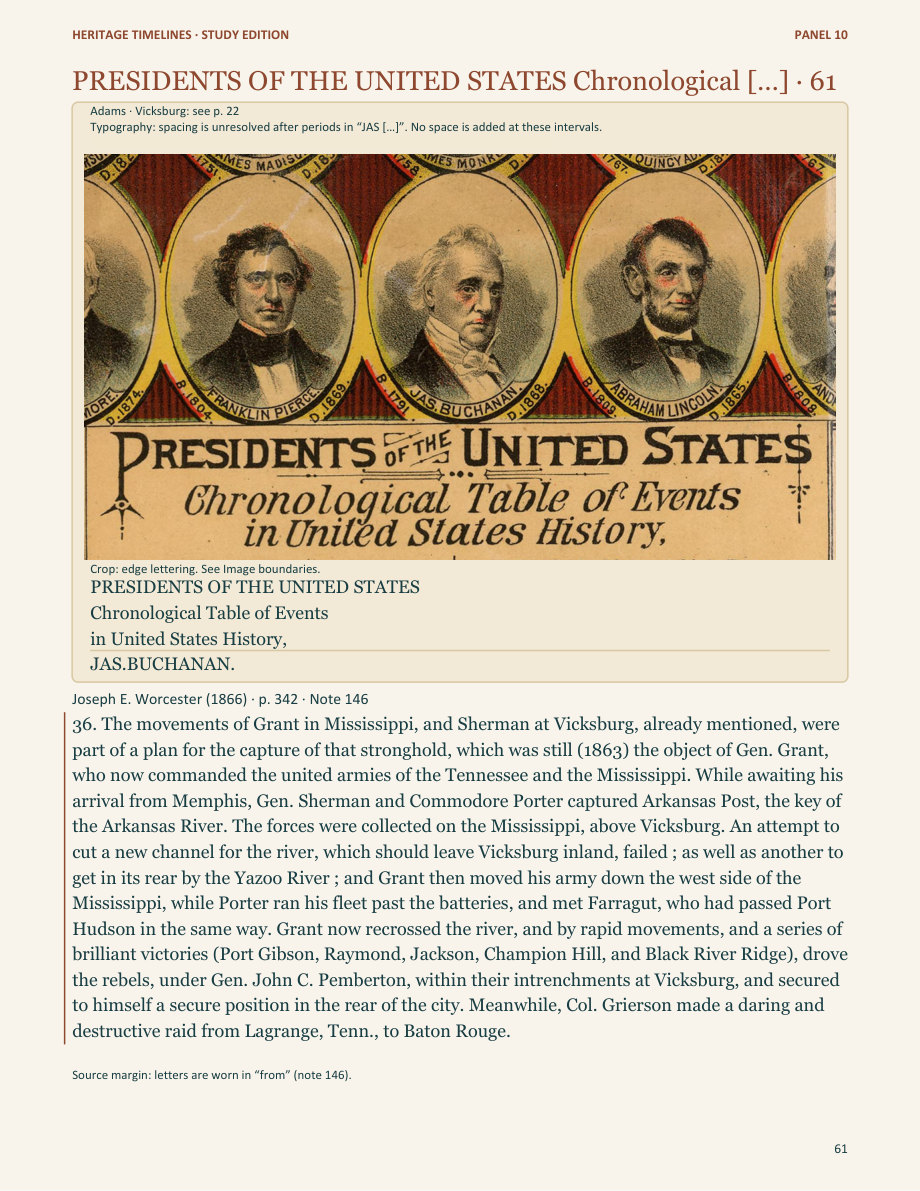
What a page of the Study Edition looks like: Adams' own words as he printed them, the Bible text, the numbers worked out again, and the other books compared, each with its title and page. Here are two pages, one from book 1 and one from book 2, with the enlarged views of the chart left out.
Heritage Timelines · Study Edition · Panel 1The story and the chart · page 32 of 106
Lives shared across generations
Adams prints one line of letteringADAM talked with SETH 800 years, and with ENOS 695 yrs. and with CAINAN 605 yrs. and with MAHALALEEL 535 yrs. and with JARED 470 yrs. and with ENOCH 308 yrs. and with METHUSELAH 243 yrs. and with LAMECH 56 yrs.
For each of eight descendants of Adam the line gives a number of years; the table shows where each number comes from.
The years of the world in the two middle columns are computed from Genesis 5: the birth year is the running total of the fathers’ ages, and the death year is the birth year plus the years lived.
800years. Seth was born in the year 130 of Adam’s life, so Adam was still alive for 930 − 130 = 800 years after Seth’s birth: the number printed after SETH.
Heritage Timelines · Study Edition · Panel 2The chart and its sources · pages 52–53 of 108
Mesha and the Moabite Stone
Adams' caption, as printed on the chartTHE MOABITE STONE. By MESHA.
Adams describes Mesha as king of Moab in the time of Ahab and presents the pillar as a memorial of successes over Israel, set up at Dibon. The date and the purpose in that sentence are Adams’ historical account.129
The biblical passage introduces Mesha as a king who raised sheep. He rendered to the king of Israel a hundred thousand lambs and a hundred thousand rams, with the wool. After Ahab’s death, the king of Moab rebels. These verses supply the people and political relationship behind the name at the top of the chart’s notice.130
2 Kings 3:4–5 · King James Version4 And Mesha king of Moab was a sheepmaster, and rendered unto the king of Israel an hundred thousand lambs, and an hundred thousand rams, with the wool. 5 But it came to pass, when Ahab was dead, that the king of Moab rebelled against the king of Israel.
The short biblical account and the memorial described by Adams concern a ruler’s relationship with Israel. They are not a transcription of one another. The caption identifies the object; the verses explain who the named king is within the biblical narrative.130
A visitor at Dibon
Klein’s account begins with a precise visit: he reached Dibân, ancient Dibon, on August 19, 1868, during a journey to Jebl Ajloon and the Belka. His companion Zattam told him of a stone with an ancient inscription among the ruins, close to their encampment, and offered to take him to see it.131,132
Adams' notice, as printed on the chartMesha, King of Moab, in the time of Ahab, (900 B. C.), in honor of his successes over Israel, set up a memorial pillar in his native city of Dibon. It was found, and good impressions of its inscription (in ancient Phœnician) were obtained in 1870.
Adams dates the obtaining of good impressions to 1870. Klein says he arrived at Dibân on August 19, 1868.131
Notes and sources
- 129Adams, Panel 2, documentary illustration
“Mesha, King of Moab, in the time of Ahab, (900 B. C.), in honor of his successes over Israel, set up a memorial pillar in his native city of Dibon. It was found, and good impressions of its inscription (in ancient Phœnician) were obtained in 1870.” - 1302 Kings 3:4-5
3:4 “And Mesha king of Moab was a sheepmaster, and rendered unto the king of Israel an hundred thousand lambs, and an hundred thousand rams, with the wool.” 3:5 “But it came to pass, when Ahab was dead, that the king of Moab rebelled against the king of Israel.” - 131Palestine Exploration Fund, Quarterly Statement (1870), p. 281, F. A. Klein, “The Original Discovery of the Moabite Stone”
Article heading: “THE ORIGINAL DISCOVERY OF THE MOABITE STONE.” “It was on the 19th of August, 1868, that in the course of a journey I undertook to Jebl Ajloon and the Belka I arrived at Dibân (ancient Dibon), about one hour to the north of the Wadi Mojeb (Arnon).” - 132Palestine Exploration Fund, Quarterly Statement (1870), p. 281, F. A. Klein, “The Original Discovery of the Moabite Stone”
“my friend Zattam, who was always most anxious to make my tour as pleasant and interesting as possible, had informed me that there was among the ruins of Dibân, scarcely ten minutes from our encampment, a most interesting stone with an ancient inscription on it which no one had ever been able to decipher, which he would take me to see.”
The Complete Study Edition gives you all ten books, with the Printable Edition of the whole chart included.