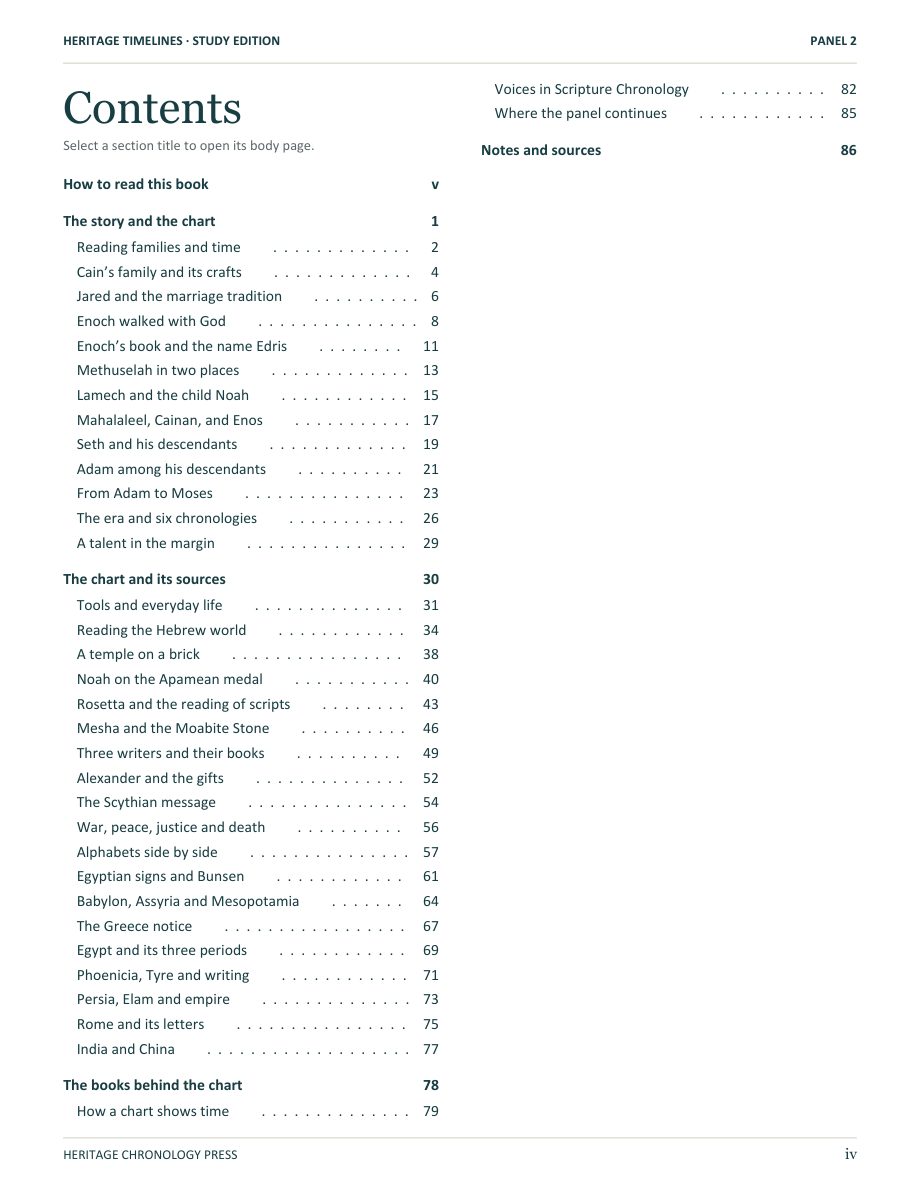
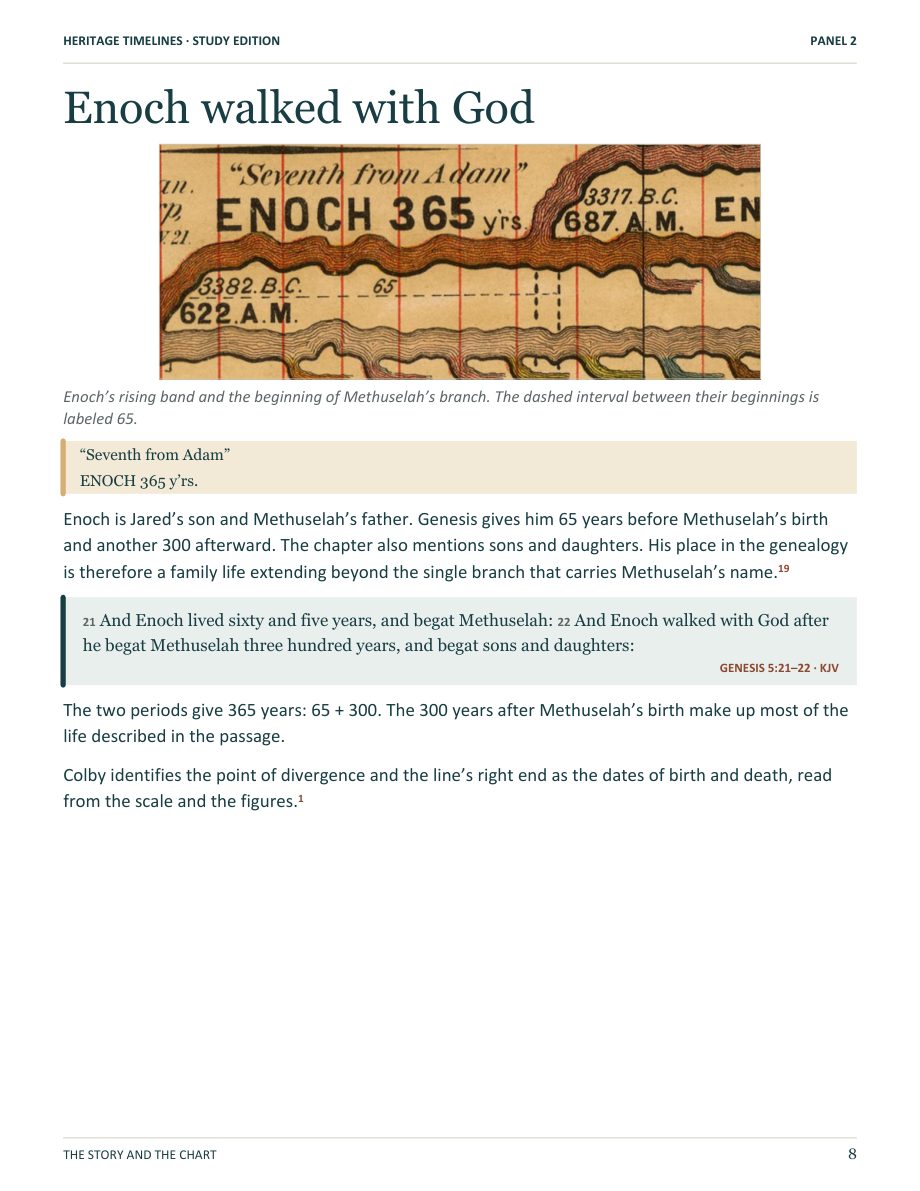
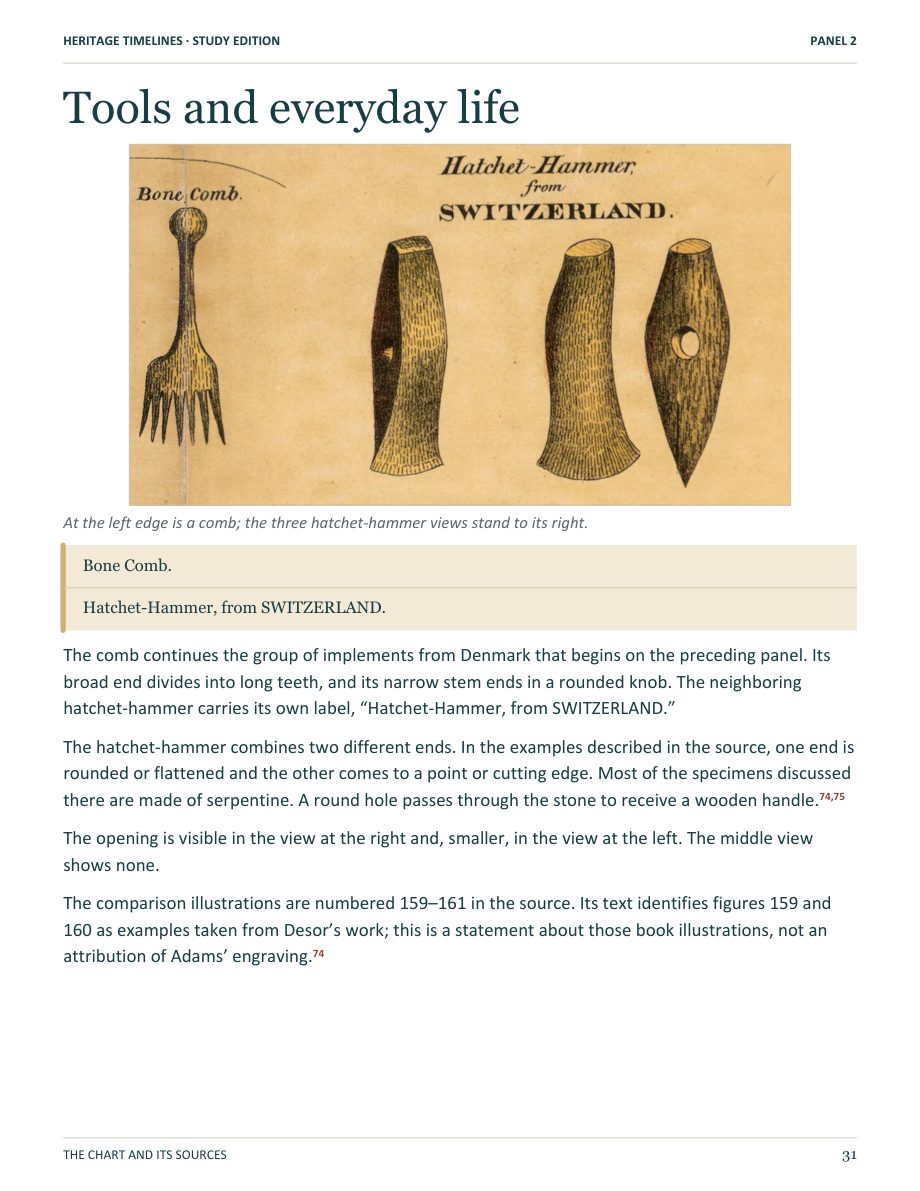
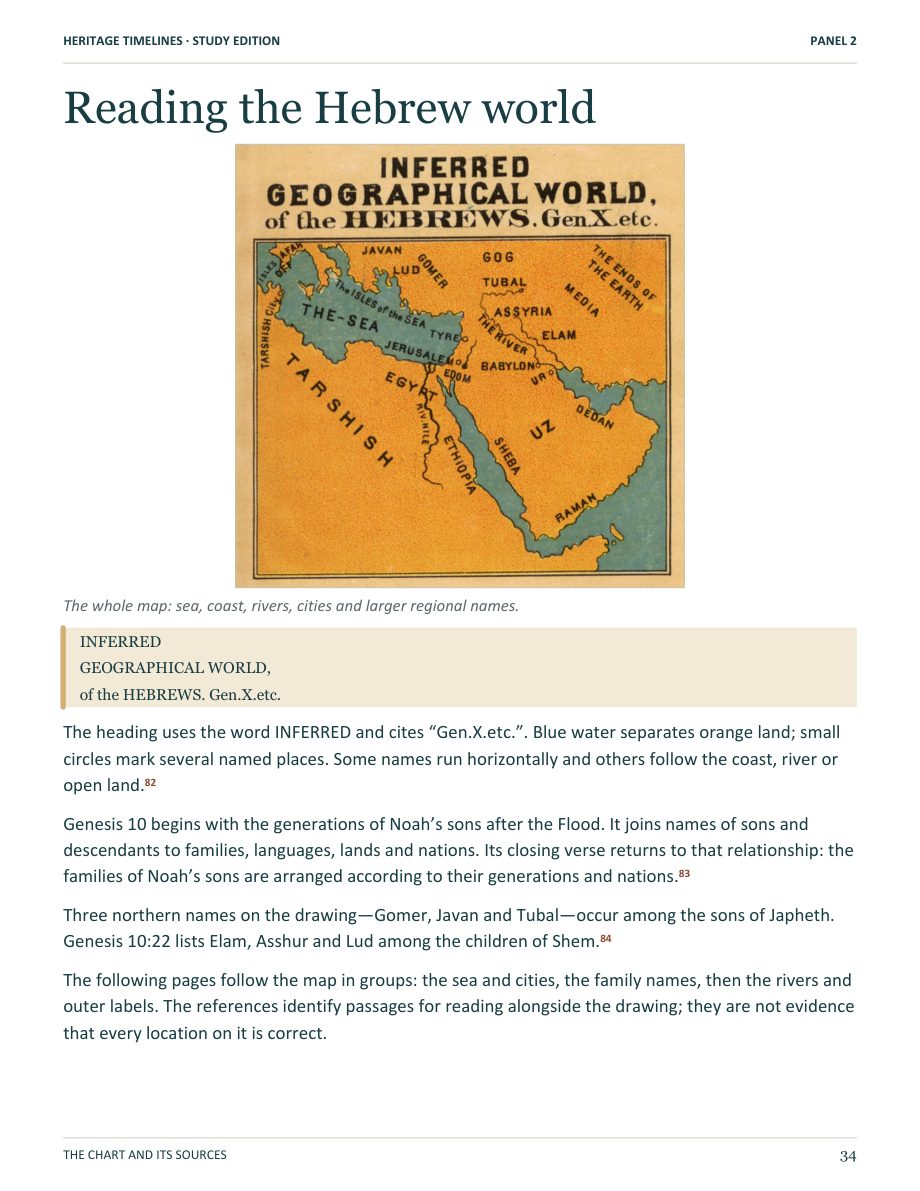
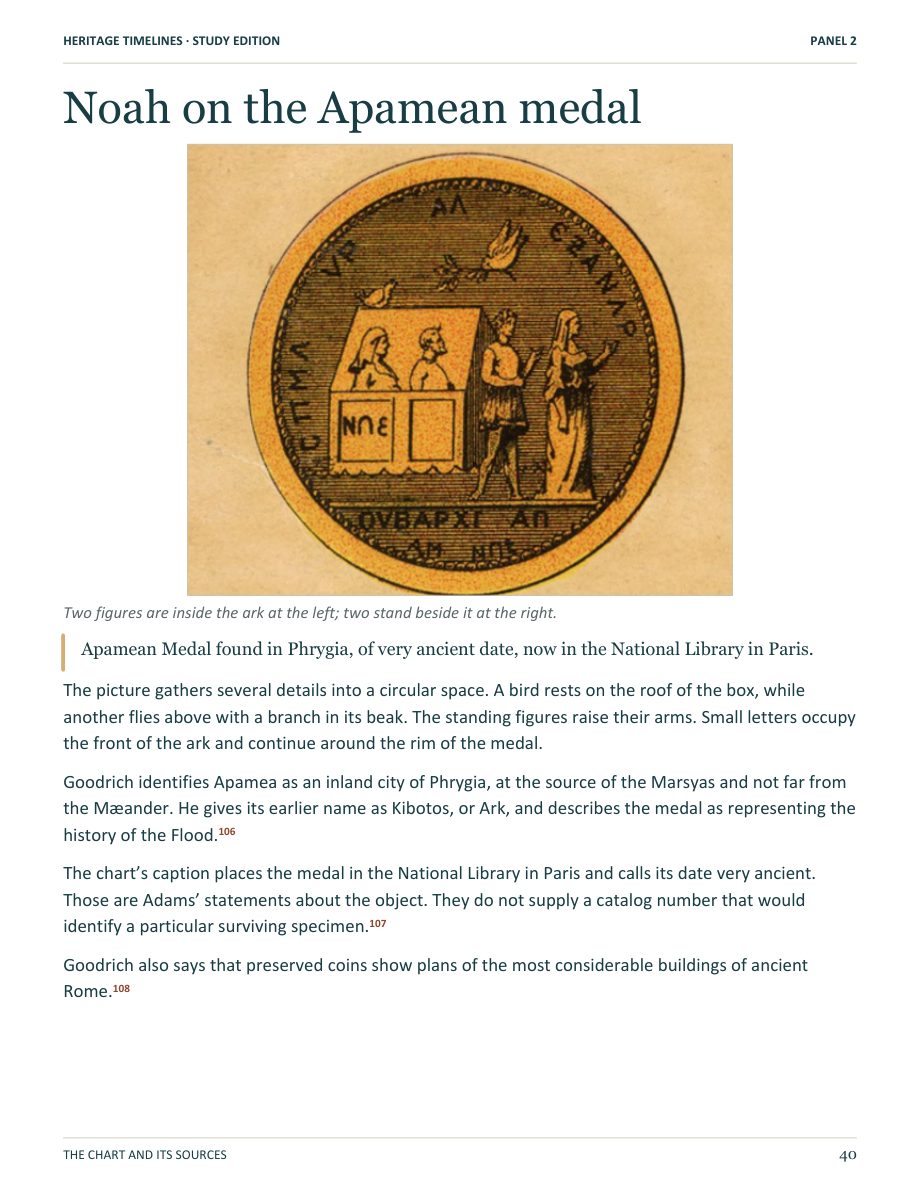
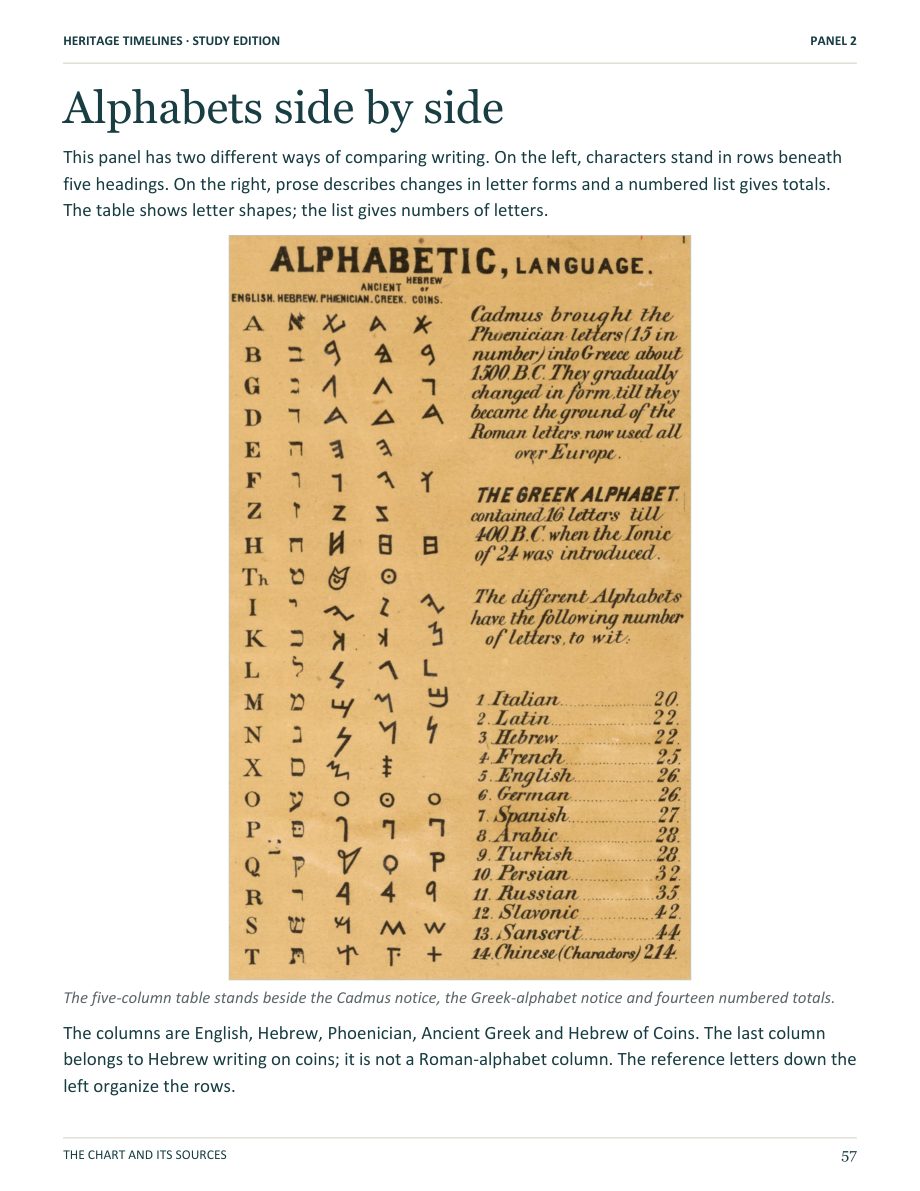
This is how every page of the book works: Adams' own words as he printed them, the Bible text, the numbers worked out again, and the other books compared, each with its title and page. Here are two pages from the book itself, with the enlarged views of the chart left out.
Heritage Timelines · Study Edition · Panel 2The story and the chart · page 19 of 108
Methuselah in two places
Adams prints, on two bandsMETHUSELAH 969 y’rs. (see below).
METHUSELAH 969 y’rs. son of Enoch.
The upper band ends beside 874 A.M., but its instruction points down to the other band. The lower beginning repeats 687 A.M. and 3317 B.C. These matching names and starting dates show the reader where to resume the same life; they do not introduce a second Methuselah.
Methuselah is Enoch’s son and Lamech’s father. Genesis gives 187 years before Lamech’s birth and 782 afterward, with other sons and daughters during the later period. His full age is 969. The son’s birth is one event inside that life, not its endpoint.34
Genesis 5:25–27 · King James Version25 And Methuselah lived an hundred eighty and seven years, and begat Lamech. 26 And Methuselah lived after he begat Lamech seven hundred eighty and two years, and begat sons and daughters: 27 And all the days of Methuselah were nine hundred sixty and nine years: and he died.
Notes and sources
- 34Genesis 5:21,25-27
5:21 “And Enoch lived sixty and five years, and begat Methuselah:” 5:25 “And Methuselah lived an hundred eighty and seven years, and begat Lamech.” 5:26 “And Methuselah lived after he begat Lamech seven hundred eighty and two years, and begat sons and daughters:” 5:27 “And all the days of Methuselah were nine hundred sixty and nine years: and he died.”
Heritage Timelines · Study Edition · Panel 2The story and the chart · pages 32–33 of 108
The era and six chronologies
Adams’ note beside a century post names the chronology adopted for his chart.
Adams' note, as printed on the chartThe era ANNO MUNDI. 4004. Before Christ according to Archbishop Usher, who follows the Hebrew Pentateuch, is here adopted. It is also the generally received standard. The most of our Histories, and accepted dates are predicated upon its chronology.
The notice names Ussher and adopts the era ANNO MUNDI, 4004 before Christ.65
Ussher’s entries put the birth of Enoch in world-year 622 and the year before Christ 3382. Adam’s death is entered at world-year 930 and 3074 before Christ. The two columns express positions on the same chronology in different directions from their respective starting points.66
For Enoch’s birth, the printed pair sums to 4004: 622 + 3382. Adam’s death gives the same total: 930 + 3074 = 4004.
Use one convention consistently when following a sequence. Switching between different creation dates halfway through a genealogy would change the calendar labels while leaving the stated ages looking unchanged. The neighboring list makes the existence of other conventions visible.
The six entries beside the adopted-era note, as printedThe HEBREW Pentateuch places
the “CREATION,” or Era ANNO MUNDI, 4004
The SAMARITAN Pentateuch 4700. B.C.
„ SEPTUAGINT „ 5872. „
„ TALMUDISTS „ 5344. „
„ JOSEPHUS „ 4658. „
and Dr. HALES „ 5411. „
The list places six chronologies side by side. Its repeated marks carry the wording and B.C. designation downward, so each figure is a proposed date for the same starting event. It is a comparison of starting dates, not six successive events.67
Hawes also places the five alternative numbers beside Ussher’s 4004. His opening entry follows Ussher’s date, described as “the most generally received standard”, and says that Ussher follows the Hebrew Pentateuch.68
In that entry, the Samaritan Pentateuch is assigned 4700, the Septuagint 5872, Josephus 4658, the Talmudists 5344, and Dr. Hales 5411. Hawes orders Josephus before the Talmudists; the chart orders its own rows as printed.69
Notes and sources
- 65Adams, Panel 2, corresponding notice
“The era ANNO MUNDI. 4004. Before Christ according to Archbishop Usher, who follows the Hebrew Pentateuch, is here adopted. It is also the generally received standard. The most of our Histories, and accepted dates are predicated upon its chronology.” - 66Ussher, Annals (1658), p. 2, margin columns for Enoch’s birth and Adam’s death
“Now Adam the first father of all man kind, died when he had lived 930 years.” - 67Adams, Panel 2, corresponding notice
“The HEBREW Pentateuch places
the “CREATION,” or Era ANNO MUNDI, 4004
The SAMARITAN Pentateuch 4700. B.C.
„ SEPTUAGINT „ 5872. „
„ TALMUDISTS „ 5344. „
„ JOSEPHUS „ 4658. „
and Dr. HALES „ 5411. „” - 68Hawes, Synchronology, opening page of Part I, First Period (unnumbered; PDF p. 31)
“Creation of the world, according to Archbishop Usher, who follows the Hebrew Pentateuch, and is here adopted as the most generally received standard.” - 69Hawes, Synchronology, opening page of Part I, First Period (unnumbered; PDF p. 31)
“The Samaritan Pentateuch places the Creation 4700, B. C.; the Septuagint, 5872; Josephus, 4658; the Talmudists, 5344; and Dr. Hales 5411.”
The whole book is 108 pages built this way, from the first families of Genesis to the scripts and the books behind the chart.