Creation and the First Patriarchs · c. 4004–3500 BC A study of Panel 1 of Adams' chart: The Creation and the First Patriarchs
106 pages
85 enlarged views of the chart
52 sections
PDF · 74.2 MB
+ panel 1 to print
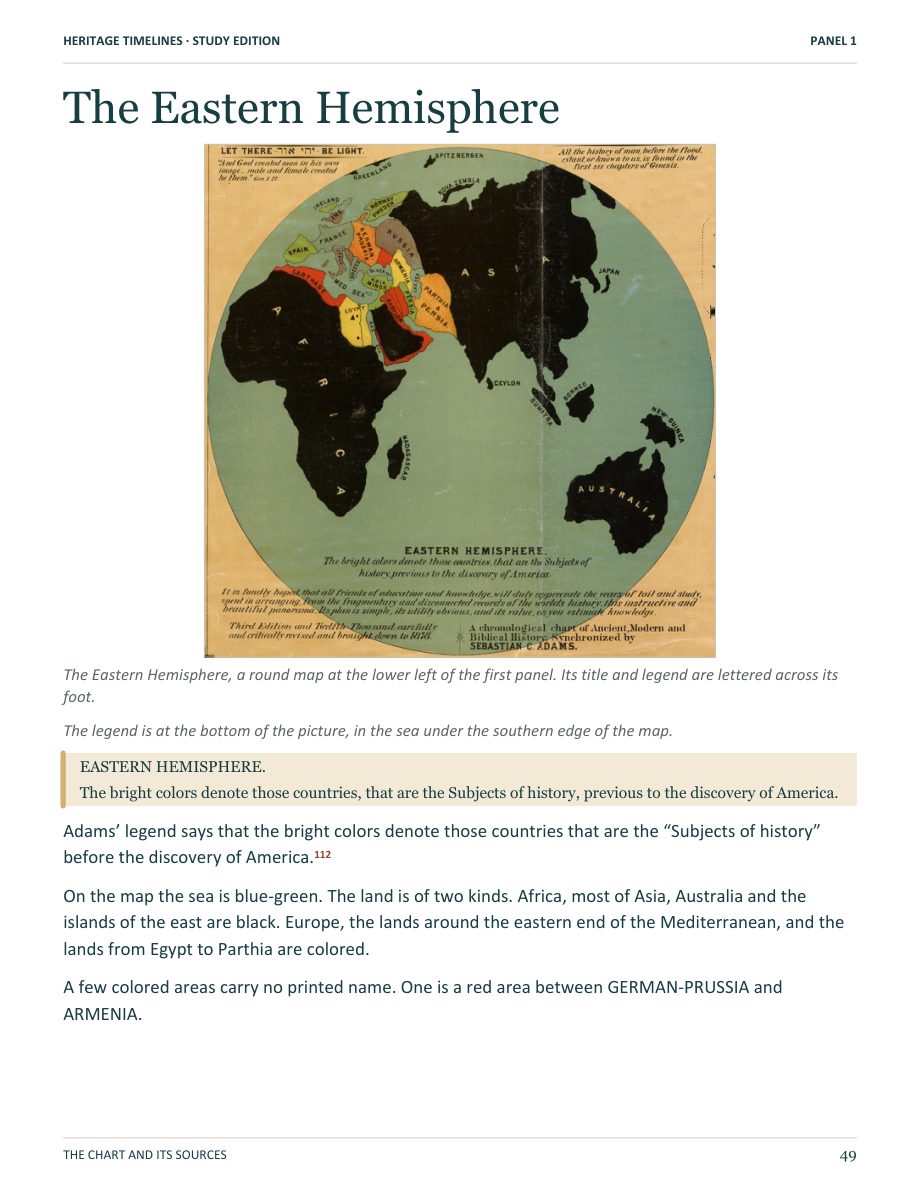
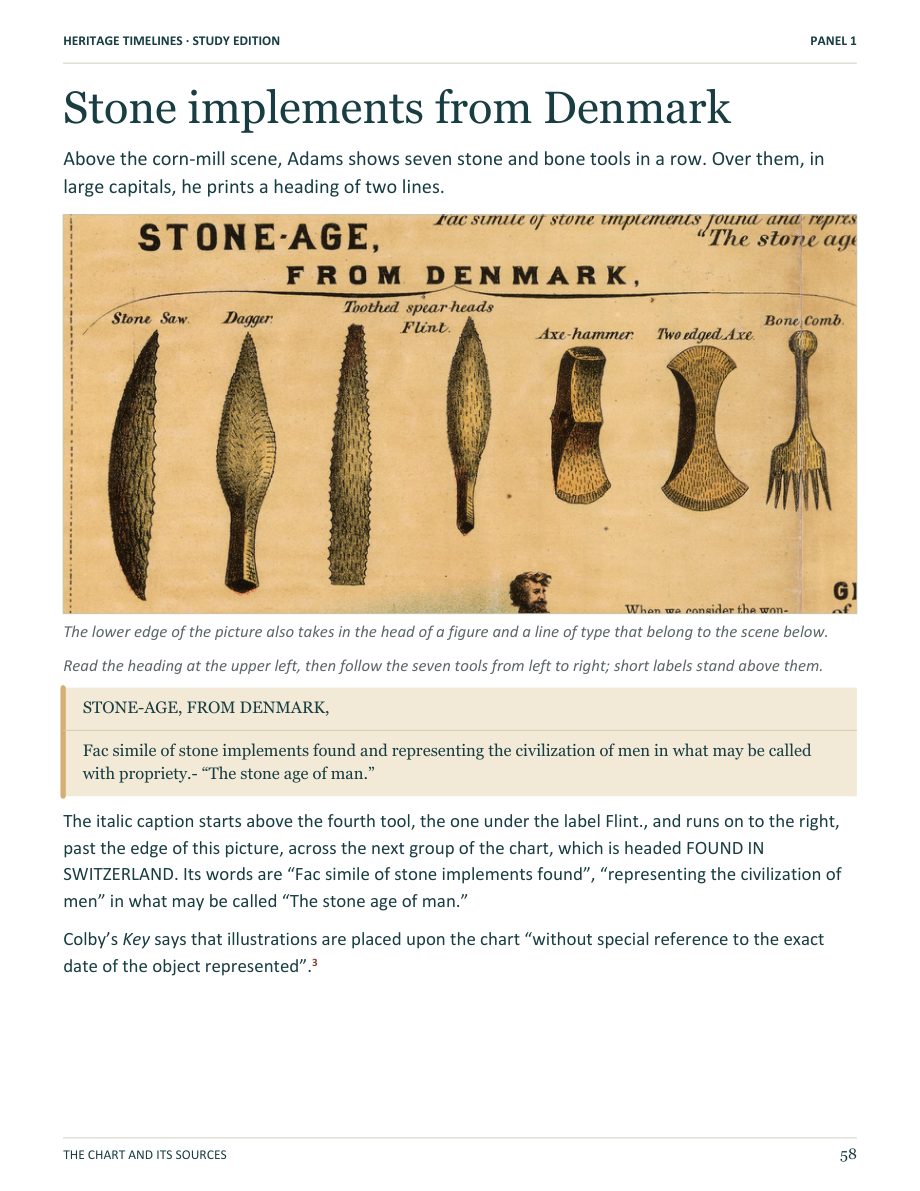
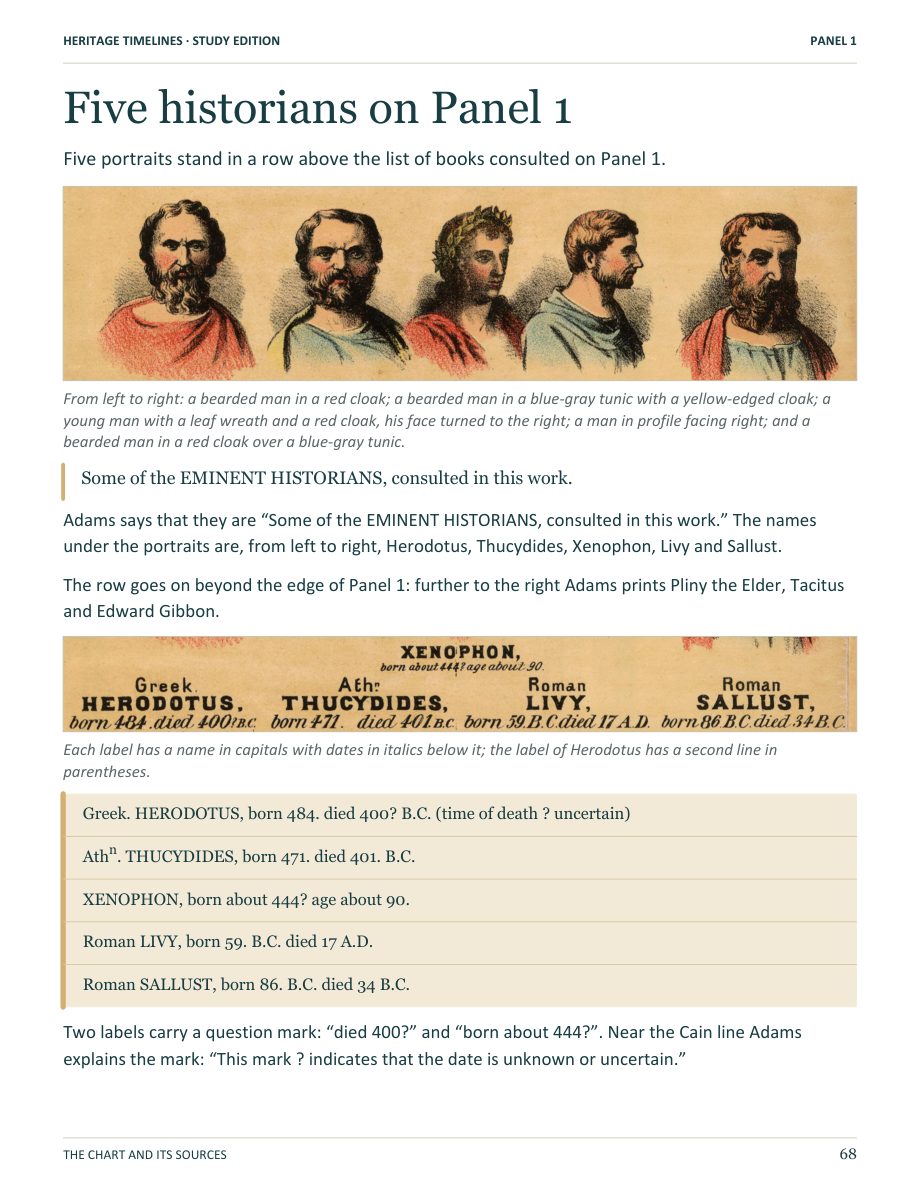
Panel 1 opens Adams' chart. This book walks through it detail by detail: the first chapters of Genesis, Cain and Abel, the line of Seth and the lives that overlap across generations, Adams' map of the Eastern Hemisphere, the Stone Age tools from Denmark, the five historians he portrays and the books he consulted. Each page sets Adams' own words and pictures beside the King James text and the sources behind them.
The Printable Edition (the whole chart, ready to print) and the 106-page Panel 1 study book, together. Digital files sent by email right after payment.
Digital PDF. Read it on any screen, zoom into every detail, print the pages you need. Also included: the complete panel 1 to print and assemble (9 sheets, US Letter or A4, about 49 x 61 cm once assembled). No printed book or chart is shipped.
What you get
Right after payment, your download links appear on screen and are sent to your email address.
Digital PDF files: nothing is mailed to you. Print the pages for your own study, your family or your classroom.
Not ready to buy? Take a free lesson instead: the Teacher’s Guide for Panel 1 has questions, printable worksheets, a quiz and answers.
Look inside
Real pages from the book. Tap a page to enlarge it.
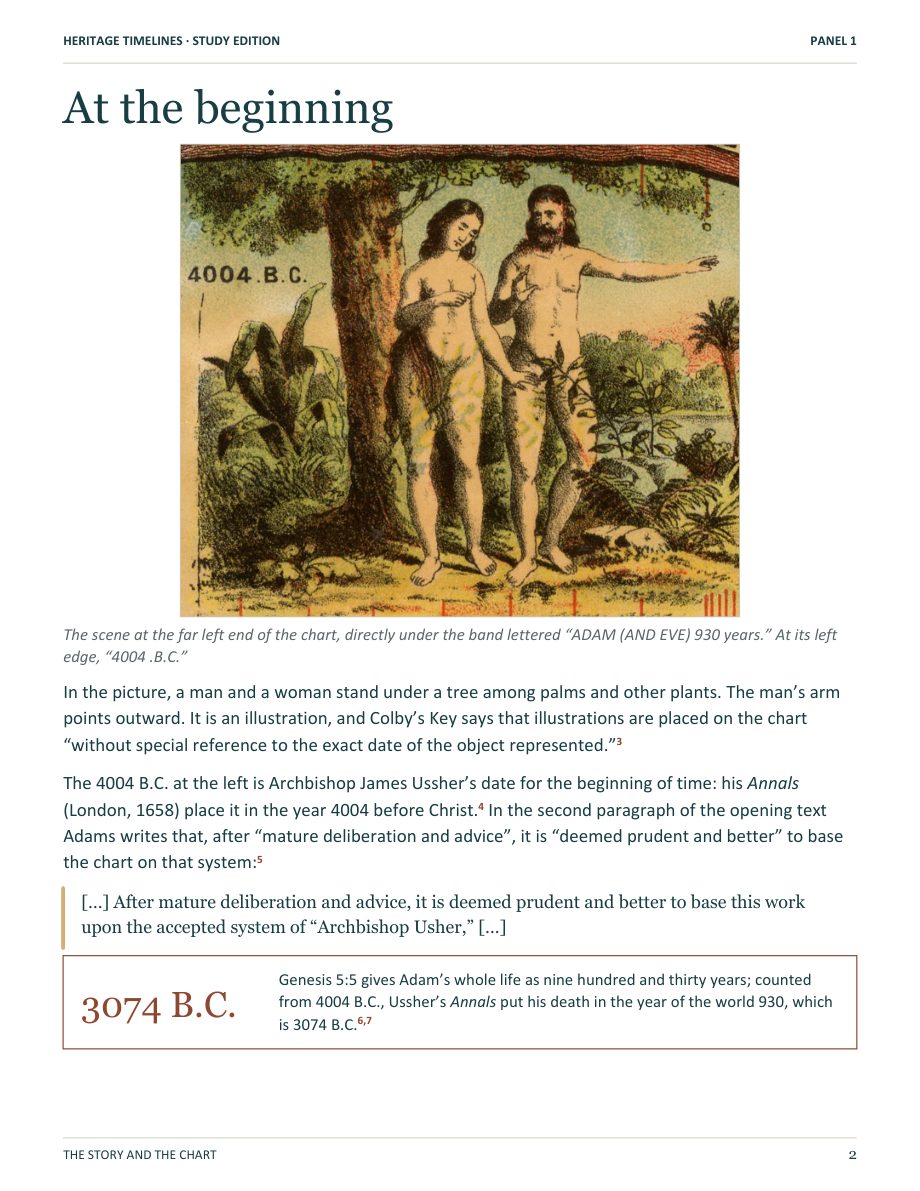
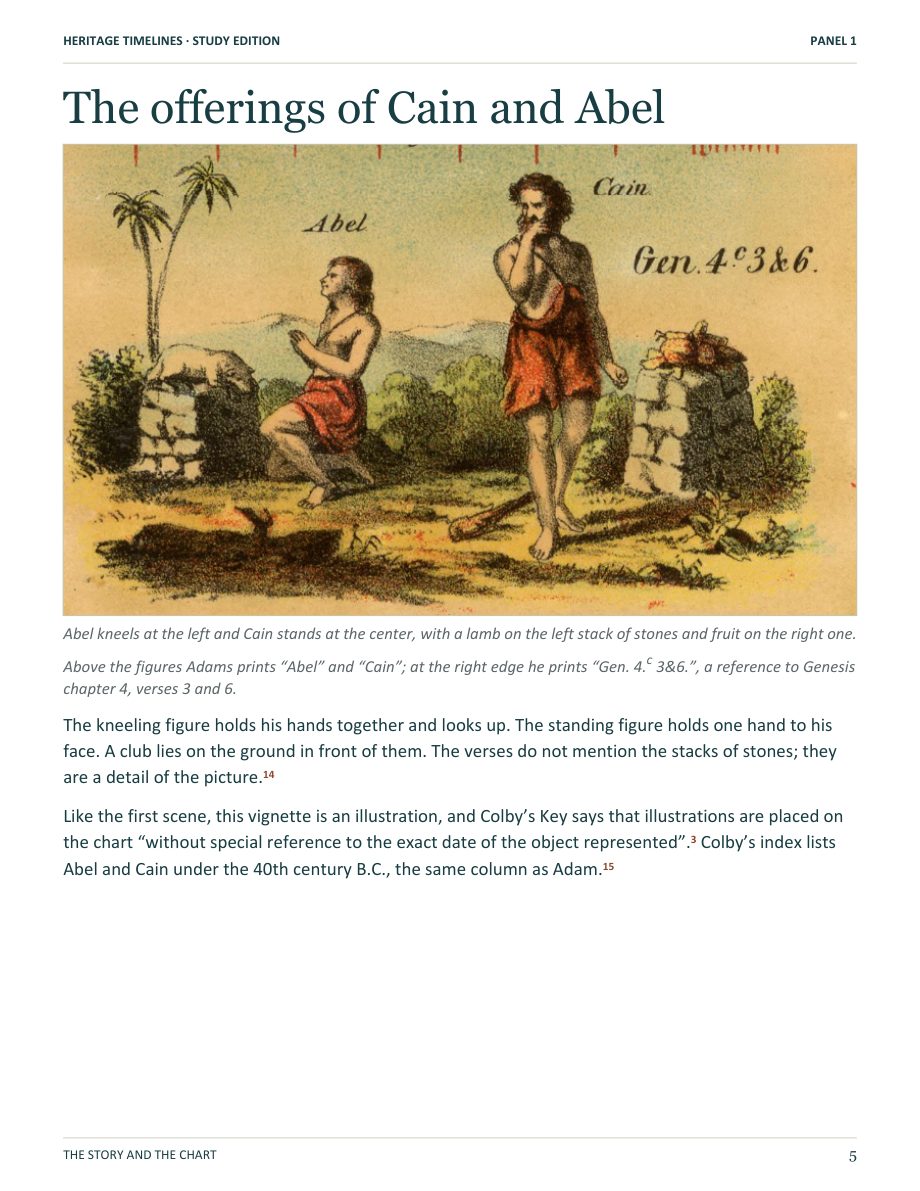
This is how every page of the book works: Adams' own words as he printed them, the Bible text, the numbers worked out again, and the other books compared, each with its title and page. Here are two pages from the book itself, in the same order and wording.
138quotations of Adams, with his own spelling and punctuation
275numbered notes, each naming the work and the page
85enlarged views of the chart, cropped from the original scan
Heritage Timelines · Study Edition · Panel 1The story and the chart · page 25 of 106
Five births, five lives
In the dates on the chart the letters A.M. stand for Anno Mundi, “year of the world,” and the B.C. dates run back from the Christian Era.46 The table gathers what Adams prints for the first five bands of Seth’s line. The last two columns are computed from those printed numbers.
Person
Born (A.M.)
Born (B.C.)
Years lived
Died (A.M.)
Died (B.C.)
Seth
130.A.M.
3874.B.C.
912
1042
2962
Enos
235.A.M.
3769.B.C.
905
1140
2864
Cainan
325.A.M.
3679.B.C.
910
1235
2769
Mahalaleel
395.A.M.
3609.B.C.
895
1290
2714
Jared
460.A.M.
3544.B.C.
962
1422
2582
Add the years lived to the year of birth and the result is the year of death; take that from 4004 and the result is the same year counted before Christ. For Seth: 130 + 912 = 1042, and 4004 − 1042 = 2962. The last of these figures is printed on panel 2, where Seth’s band ends: “2962.B.C. 1042.A.M”.
Two other books
Ussher’s Annals print the same years before Christ for these five deaths in the margin of page 3: 2962, 2864, 2769, 2714 and 2582.47 Calmet’s chronological table gives the same years of the world for these births and deaths, from 130 for Seth to 1422 for the death of Jared.48
Born
Adams (B.C.)
Calmet (B.C.)
Difference
Seth
3874
3870
4
Enos
3769
3765
4
Cainan
3679
3675
4
Mahalaleel
3609
3605
4
Jared
3544
3540
4
In Calmet’s table the years before Christ start from 4000 for the Creation, so each birth is four years below the figure on Adams’ chart; the years of the world are the same in both. The table’s heading says that its author places the birth of Christ four years before the common era.49
Notes and sources
46Colby, Key, pp. 6–7 “From the Creation of man to the Christian Era dates are styled A. M. (Anno Mundi, year of the world); from the beginning of the Christian Era to the present they are styled A. D. (Anno Domini, year of the Lord); and these dates are all shown above the ‘century posts,’ while the B. C. dates are placed below them, and run from the Christian Era back to the time of Adam.”
47Ussher, Annals (1658), p. 3, margin columns, and text Text: “Seth the son of Adam died when he had lived 912 years”; “Noah the tenth from Adam, was born when his father Lamech had lived 182 years”. Margin, year before Christ: 2962 (Seth’s death), 2948 (Noah’s birth), 2864, 2769, 2714, 2582 (the deaths of the next four patriarchs).
48Calmet, Dictionary, general chronological table, first page (PDF p. 969, after printed p. 946) Column “Year of the World,” Calmet: Seth born 130; Enos 235; Cainan 325; Mahalaleel 395; Jared 460; Enoch 622; Methuselah 687; Lamech 874; Adam dies 930; Enoch translated 987; Seth dies 1042; Noah born 1056; Enos dies 1140; Cainan dies 1235; Mahalaleel dies 1290; Jared dies 1422. Column “Year before Christ,” Calmet: The Creation 4000; Seth born 3870; Enos 3765; Cainan 3675; Mahalaleel 3605; Jared 3540.
49Calmet, Dictionary, general chronological table, first page (PDF p. 969, after printed p. 946) “The Author places the true date of the birth of Christ four years before the common Era, or A. D.” “A. M. 1 corresponds to the 710th year of the Julian Period.” “We have added the Chronology adopted by Dr. Hales”
Heritage Timelines · Study Edition · Panel 1The chart and its sources · page 41 of 106
A notice to the critic
Adams says three things in it. He is not responsible for the truth of any history or system; it is “only presented as it is found”. He calls Adam “the first man found in any history, monument or inscription”, whose name, creation and death are “Matters of record”. And he says that historic information from any critic about an earlier person or people, with all the specified dates, will be “most thankfully received”.
Adams' notice, as printed on the chartIt is hoped that the critic will remember that the author is not responsible for the truth of any history or system. It is only presented as it is found. “ADAM,” is the first man found in any history, monument or inscription; whose name, the time of his creation, and death, are Matters of record, and from whom his descendants can be traced by name and age, in successive links for near 4000 years. If any critic has historic information of any person and people that antedate those given, having all these specified dates, it will be most thankfully received, and properly considered in subsequent editions of this work.
Genesis 5 is the chapter that gives such details: Adam’s age at the birth of Seth, 130, and at his death, 930, then for each father down to Noah the age at the birth of the next son.6,89
Genesis 5:3–5 · King James Version3 And Adam lived an hundred and thirty years, and begat a son in his own likeness, and after his image; and called his name Seth: 4 And the days of Adam after he had begotten Seth were eight hundred years: and he begat sons and daughters: 5 And all the days that Adam lived were nine hundred and thirty years: and he died.
Notes and sources
6Genesis 5:5 (KJV) “And all the days that Adam lived were nine hundred and thirty years: and he died.”
89Genesis 5:3–32 (KJV) Each father’s age at the birth of the next, and each whole life: Adam 130 (930); Seth 105 (912); Enos 90 (905); Cainan 70 (910); Mahalaleel 65 (895); Jared 162 (962); Enoch 65 (365); Methuselah 187 (969); Lamech 182 (777); Noah 500 at the birth of Shem, Ham and Japheth.
The whole book is 106 pages built this way, from the first chapters of Genesis to the books Adams consulted, and the panel to print comes with it.
Adams' original wording, transcribed with his own spelling and punctuation: 138 quotations
King James quotations copied word for word from the KJV text
Enlarged details of the chart, each with its caption and explanation
275 numbered notes, each naming the work and the page; the books Adams relied on, identified and compared with his text
The complete panel 1, ready to print at large size (9 sheets, US Letter or A4, about 49 x 61 cm once assembled)
Print and study
You may print the pages for your own study, your family or your classroom, as often as you need. Corrections and improvements to this edition are sent free to buyers. Please do not share or resell the file.
Use it beside the chart itself: Panel 1 on adamschart.org lets you zoom into every scene the book explains.
Which book is for you?
Two kinds of books follow the same panels of Adams’ chart, for two kinds of readers.
For adults and teachers
Study Edition: understand every detail
Every detail of the panel explained
Adams’ own words, the King James text and his sources
The two are sold separately: the complete Study Edition does not include the illustrated books. Both are digital (PDF): nothing is mailed to you.
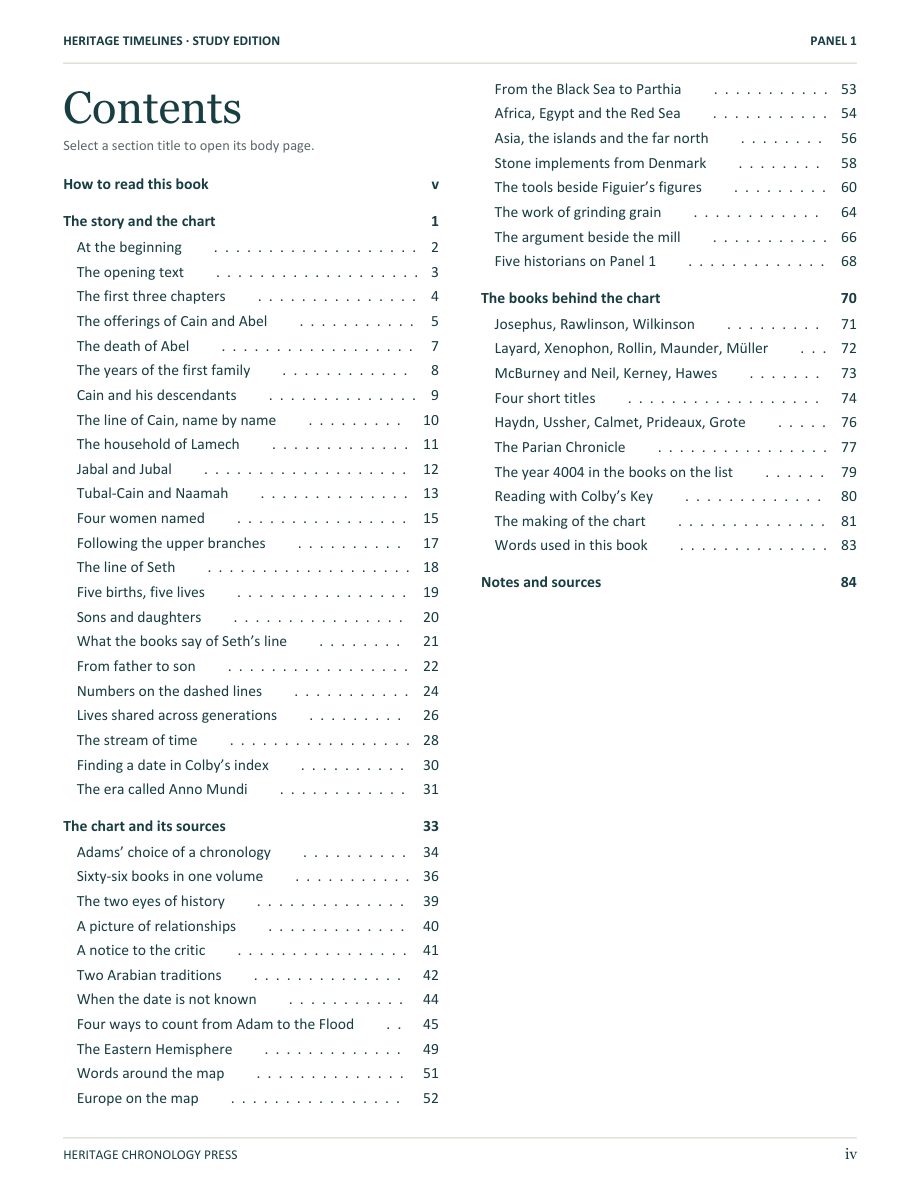
Contents
52 sections in three parts, then the notes: 106 pages. Page numbers are those of the PDF.
The story and the chart23 sections · pp. 7–38
At the beginning8
The opening text9
The first three chapters10
The offerings of Cain and Abel11
The death of Abel13
The years of the first family14
Cain and his descendants15
The line of Cain, name by name16
The household of Lamech17
Jabal and Jubal18
Tubal-Cain and Naamah19
Four women named21
Following the upper branches23
The line of Seth24
Five births, five lives25
Sons and daughters26
What the books say of Seth’s line27
From father to son28
Numbers on the dashed lines30
Lives shared across generations32
The stream of time34
Finding a date in Colby’s index36
The era called Anno Mundi37
The chart and its sources19 sections · pp. 39–75
Adams’ choice of a chronology40
Sixty-six books in one volume42
The two eyes of history45
A picture of relationships46
A notice to the critic47
Two Arabian traditions48
When the date is not known50
Four ways to count from Adam to the Flood51
The Eastern Hemisphere55
Words around the map57
Europe on the map58
From the Black Sea to Parthia59
Africa, Egypt and the Red Sea60
Asia, the islands and the far north62
Stone implements from Denmark64
The tools beside Figuier’s figures66
The work of grinding grain70
The argument beside the mill72
Five historians on Panel 174
The books behind the chart10 sections · pp. 76–89
Josephus, Rawlinson, Wilkinson77
Layard, Xenophon, Rollin, Maunder, Müller78
McBurney and Neil, Kerney, Hawes79
Four short titles80
Haydn, Ussher, Calmet, Prideaux, Grote82
The Parian Chronicle83
The year 4004 in the books on the list85
Reading with Colby’s Key86
The making of the chart87
Words used in this book89
Notes and sourcespp. 90–106
Numbered notes with their sources, in the order of the book.
Questions
How do I receive the book?
Right after payment, your download link appears on screen and is sent to your email address.
Is this the printed chart?
No. This is a PDF book that explains the chart. The complete chart itself is free to explore on adamschart.org.
Which devices can open it?
Any computer, tablet or phone with a PDF reader. Pages are US Letter size and print well on A4 with "fit to page".
Best value
Panel 1 book + Printable Edition
The Printable Edition (the whole chart, ready to print) and the 106-page Panel 1 study book, together. Digital files sent by email right after payment.