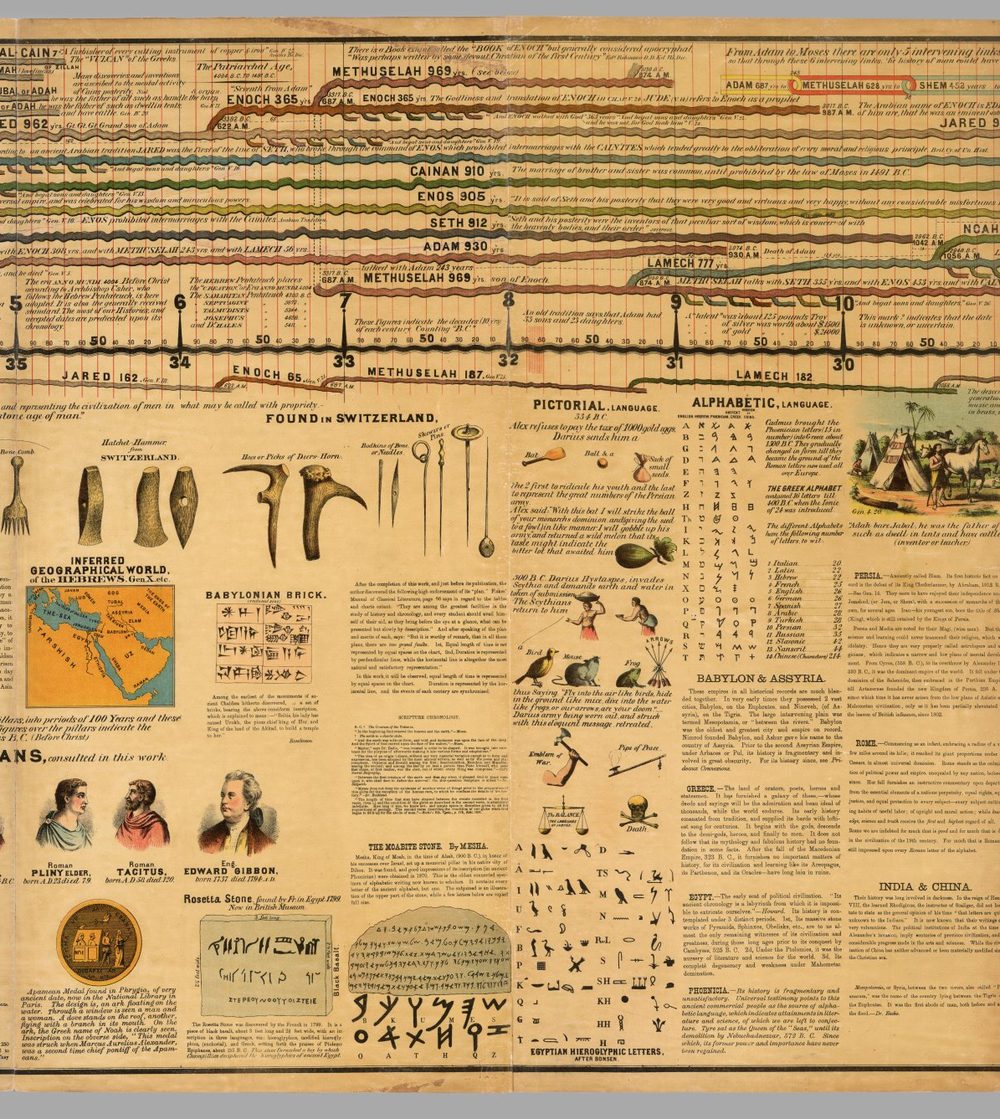
Panel 2 of Sebastian C. Adams' Synchronological Chart covers roughly 3500 to 2900 BC, the world before the Flood as Genesis describes it. Adams dates few events in these centuries, so he gives the panel to two things: the long lives of the patriarchs from Adam to Noah, and a set of introductions that prepare the reader for the rest of the chart, on chronology, on the great nations and on the history of writing.
The Patriarchs from Adam to Noah
Adams draws each patriarch's life as a line running through the centuries and labels it with the years he lived, among them Adam 930, Enos 905, Cainan 910, Jared 962, Methuselah 969 and Lamech 777. These are the ages given in Genesis, the same that Archbishop James Ussher uses. Adams also gives shorter numbers: the age at which a patriarch became the father of the next in line, such as "Lamech 182," the age Ussher gives for Lamech at the birth of Noah.
The chart records the death of Adam, and the line reaches Noah before the panel ends. Adams even counts how long these lives overlapped. A note begins "Methuselah talks with Seth" and gives the number of years the two men shared.
Enoch
Of all the patriarchs, Enoch stands apart. Adams calls him the "Seventh from Adam" and records "The Godliness and translation of Enoch" after a life of 365 years. He adds that Jude refers to Enoch as a prophet, and that a "Book of Enoch" exists but is "generally considered apocryphal."
The chart follows the line of Cain as well. Of Jabal, son of Adah, Adams writes that "he was the father of such as dwell in tents and have cattle."
Scripture Chronology
Adams explains his dating in a block headed "Scripture Chronology." His standard is the era Anno Mundi, beginning in 4004 BC, taken from Ussher, who, in the chart's words, "follows the Hebrew Pentateuch." He compares it with other reckonings, among them the Septuagint, Josephus and the Talmudists. He also explains that a question mark on the chart means a date is unknown or uncertain.
The Nations Before Their History
The panel introduces the peoples whose history fills the rest of the chart, with short sketches of Babylon and Assyria, Persia, Egypt, Phoenicia, Greece, Rome, and India and China. Egypt is "The early seat of political civilization." Greece is "The land of orators, poets, heroes and statesmen." Persia was "Anciently called Elam." Phoenicia, Adams writes, is the "source of alphabetic language."
Writing, Stones and Relics
Adams traces the history of writing in three blocks: "Pictorial Language," "Egyptian Hieroglyphic Letters, after Bunsen" and "Alphabetic Language." He illustrates picture writing with the message the Scythians sent to Darius: a bird, a mouse, a frog and arrows. He credits Cadmus with bringing the Phoenician letters into Greece, where in time they became "the ground of the Roman letters now used all over Europe."
The chart also gathers objects that shed light on the ancient world. "The Rosetta Stone was discovered by the French in 1799." The Moabite Stone is a memorial pillar set up by a king of Moab. Adams shows a Babylonian brick, and the Apamean Medal from Phrygia, whose design shows an ark floating on the water, with a dove. A hatchet hammer, picks of deer horn and bodkins of bone are marked "Found in Switzerland," and a small map is titled "Inferred Geographical World of the Hebrews."
Explore Panel 2
Open the panel in the interactive chart to read these entries in Adams' own words. Search for "Methuselah," "Enoch," "Rosetta" or "Moabite" to jump straight to them.