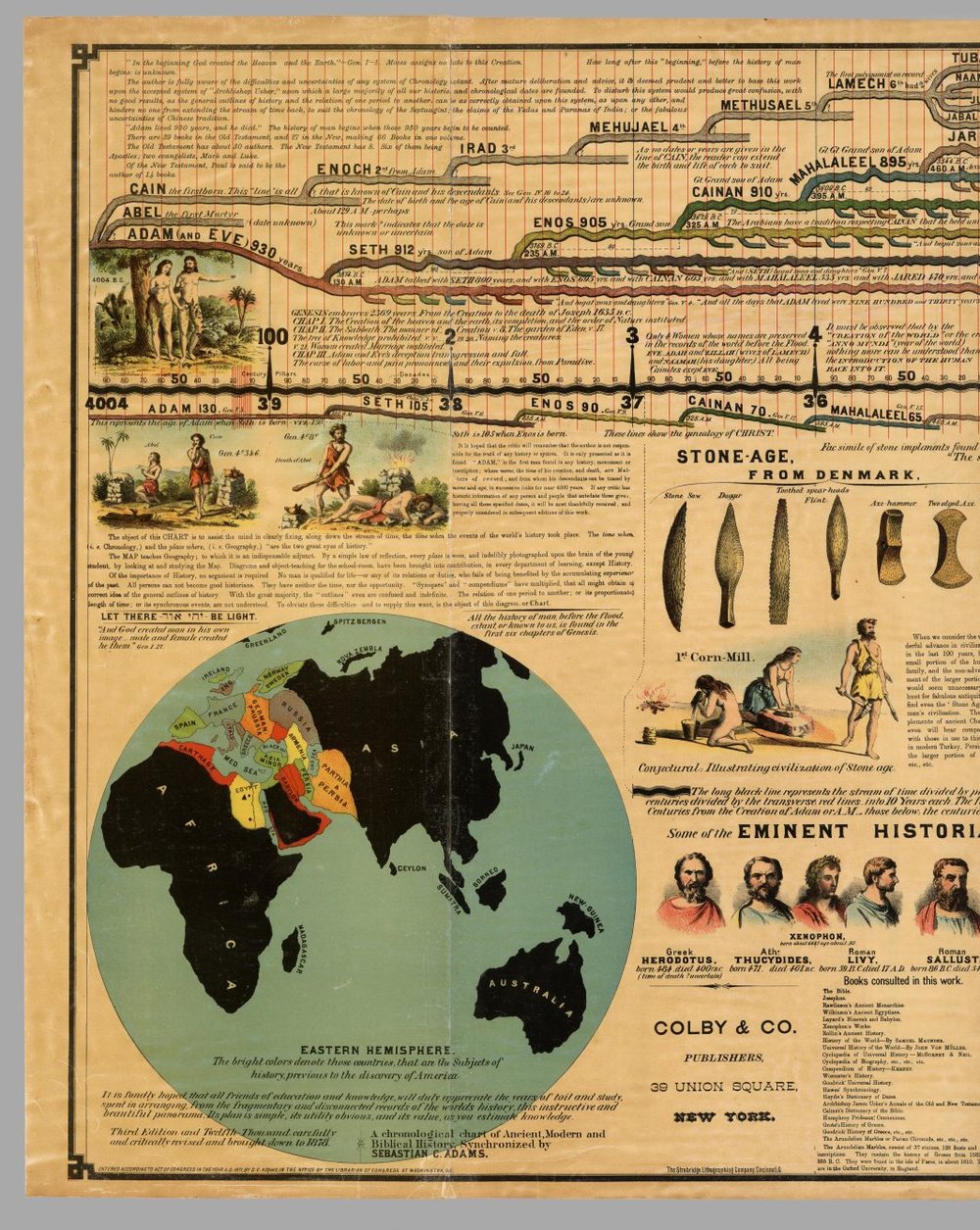
Panel 1 of Sebastian C. Adams' Synchronological Chart covers roughly 4004 to 3500 BC, the first five centuries of his timeline. It opens with the Creation and follows the first generations of Genesis: Adam and Eve, Cain and Abel, and the long-lived patriarchs from Seth to Jared. And because it is the first panel, it also carries the chart's title, its explanations and the list of books Adams consulted.
Where the Chart Begins
Adams starts his count at 4004 BC, the date that Archbishop James Ussher gives for the Creation. He explains that he bases the whole chart on the accepted system of Ussher, and he adds that "Moses assigns no date to this Creation." The panel quotes the opening words of Genesis, "In the beginning God created the Heaven and the Earth," and prints "Let there be light" in English and Hebrew.
It also explains how to read the chart: "The long black line represents the stream of time," divided into centuries by pillars and into decades by red lines. He counts the years both BC and from the Creation, as Anno Mundi, the "year of the world." A special mark flags dates that are "unknown or uncertain."
Adam, Seth and the Patriarchs
Adams writes: "All the history of man, before the flood, extant or known to us is found in the first six chapters of Genesis." He draws the lives of Adam and Eve and their descendants from those chapters. For Adam he quotes Genesis directly: "Adam lived 930 years, and he died." Seth is born when Adam is 130, and Seth himself lives 912 years. After Seth come Enos, Cainan, Mahalaleel and Jared.
A running note counts the years that Adam "talked with" each of these descendants, from Seth to Jared. Adams also begins a line that shows "the genealogy of Christ."
Cain and Abel
Adams calls Abel "the first Martyr" and records the death of Abel. Of Cain's family he writes: "The date of birth and the age of Cain (and his descendants) are unknown." Their names therefore appear without dates: Enoch, Irad, Mehujael, Methusael and Lamech, whom Adams calls "The first polygamist on record." The family closes with the children of Lamech, Jabal, Jubal, Tubal and Naamah.
The Stone Age
The panel also looks at the earliest tools. Under the heading "Stone-Age, from Denmark," Adams illustrates a stone saw, a dagger, toothed spear-heads of flint, an axe-hammer and a two-edged axe. He also shows a first corn-mill, and he labels one group of illustrations "Conjectural: Illustrating civilization of Stone age." He adds his own view that the implements of ancient Chaldea "will bear comparison" with those still in use in his day in Turkey and Persia.
Adams' Introduction
As the opening panel, it carries the chart's title, "A chronological chart of Ancient, Modern and Biblical History," and Adams' statement of purpose: "to assist the mind in clearly fixing, along down the stream of time, the time when the events of the world's history took place." Time and place, he writes, are "the two great eyes of history," and he adds a map of the Eastern Hemisphere, which he calls "an indispensable adjunct."
Adams also lists the "Books consulted in this work," among them Ussher's Annals, Josephus, Rollin's Ancient History, Rawlinson's Ancient Monarchies and Haydn's Dictionary of Dates. He names "Some of the eminent historians," Herodotus, Thucydides, Xenophon, Livy and Sallust. A short note describes the Arundelian Marbles, or Parian Chronicle, which "contain the history of Greece." They were found on the island of Paros and, Adams notes, are kept at Oxford University in England.
Explore Panel 1
Open the panel in the interactive chart to read these entries in Adams' own words. Search for "Seth," "Naamah," "Stone-Age" or "Arundelian" to jump straight to them.