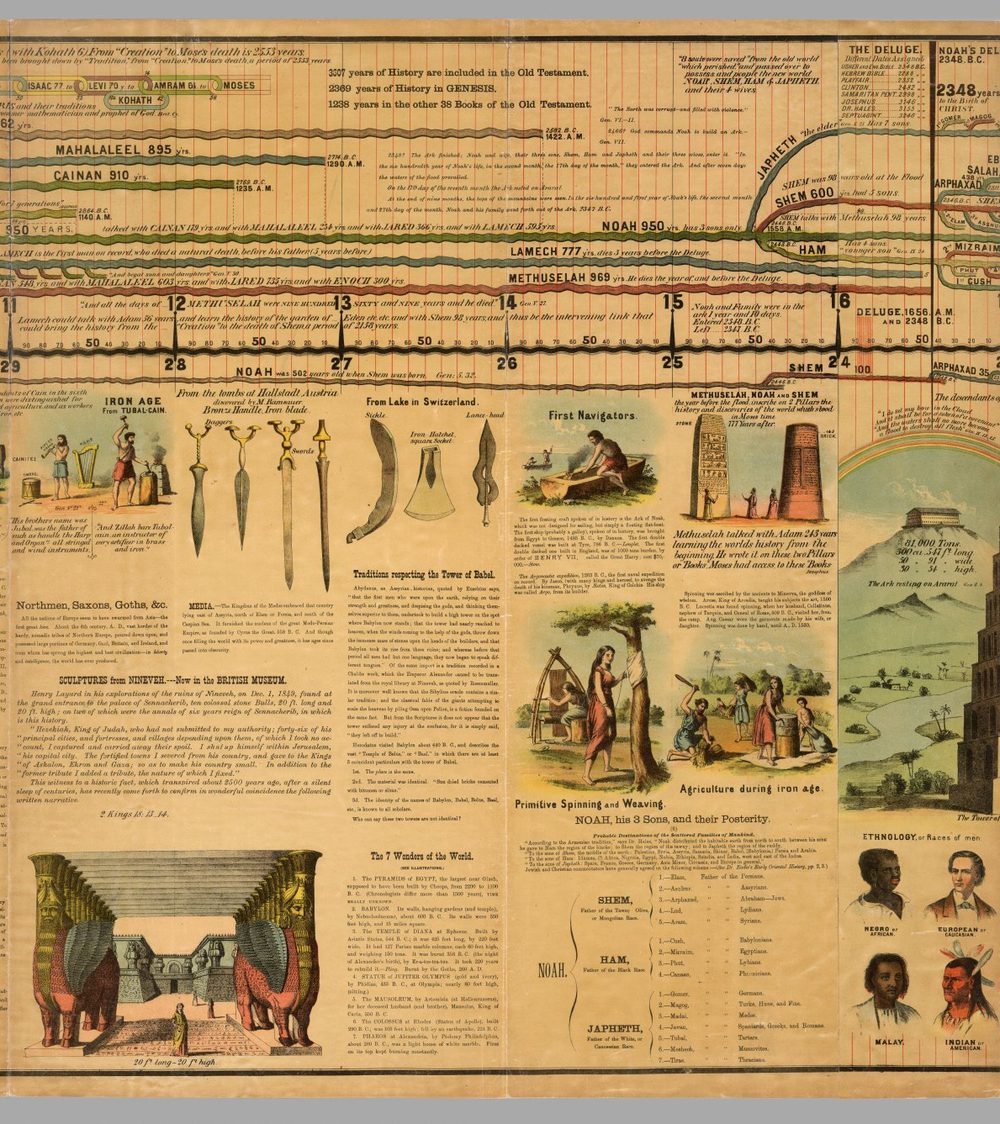
Panel 3 of Sebastian C. Adams' Synchronological Chart covers roughly 2900 to 2300 BC. Its great event is the Deluge, which Adams dates, following Archbishop James Ussher, to 2348 BC. The panel follows the last generations before the Flood, the family of Noah, and the first spreading of peoples afterward. It also carries some of the longest texts on the chart, on subjects that reach far beyond these centuries: the Tower of Babel, the Seven Wonders of the World, the races of mankind and the earliest crafts.
The last generations before the Flood
The long lives of the first patriarchs come to an end here. Adams gives Lamech 777 years and notes that he "dies 5 years before the Deluge." Methuselah, with 969 years, "dies the year of, and before the Deluge." These are the lifespans that Ussher gives.
Noah and the Ark
Adams names those saved from the Flood as "Noah, Shem, Ham & Japheth," together with their wives, and records that "Shem was 98 years old at the flood." The chart shows the Ark resting on Ararat, and closes the story with the words of Genesis: "I do set my bow in the Cloud."
The date itself was disputed, and the chart says so. A list headed "Different Dates Assigned" compares the date given by Ussher and the English Bible with those of other authorities, among them the Hebrew Bible, the Samaritan Pentateuch, the Septuagint, Josephus, Clinton, Playfair and Dr. Hales. Haydn's Dictionary of Dates prints a very similar table.
The families of mankind
A section headed "Noah, his 3 Sons, and their Posterity" follows the peoples descended, in Adams' account, from Shem, Ham and Japheth. It pairs their sons with nations: Asshur with the Assyrians, Mizraim with the Egyptians, Canaan with the Phoenicians, and Javan with the "Spaniards, Greeks, and Romans."
A second heading, "Probable Destinations of the Scattered Families of Mankind," quotes Dr. Hales on an Armenian tradition that Noah divided the earth among his sons. A third, "Ethnology, or Races of men," sets out the division of humanity into races that was common in the nineteenth century.
Babel and the Seven Wonders
Adams gathers "Traditions respecting the Tower of Babel," among them the account of Abydenus as quoted by Eusebius. He then compares the Tower with the "Temple of Belus" that Herodotus described after visiting Babylon, noting that "The place is the same" and "The material is identical," and he asks: "Who can say these two towers are not identical?"
The panel also lists "The 7 Wonders of the World," from the Pyramids of Egypt to the Pharos at Alexandria, including the hanging gardens of Babylon, the Temple of Diana at Ephesus and the Colossus at Rhodes. Of the Pyramids, "supposed to have been built by Cheops," Adams writes that chronologists differ and that the time is "REALLY UNKNOWN."
The first crafts, and a witness from Nineveh
The chart illustrates early crafts in several entries: "Primitive Spinning and Weaving," "First Navigators" and "Agriculture during iron age." The "Iron Age" itself is traced "From Tubal-cain," who in the words the chart quotes from Genesis was "an instructor of every artificer in brass and iron," and it is illustrated with iron weapons, including finds from ancient tombs in Austria.
A long text headed "Sculptures from Nineveh" tells how Henry Layard found colossal stone bulls at the palace of Sennacherib, two of them inscribed with the annals of his reign. Adams quotes the passage that names "Hezekiah, King of Judah," and calls the find a "witness to a historic fact," pointing to the account in the Second Book of Kings.
Explore Panel 3
Open the panel in the interactive chart to read these entries in Adams' own words. Search for "Deluge," "Babel," "Wonders" or "Tubal-cain" to jump straight to them.