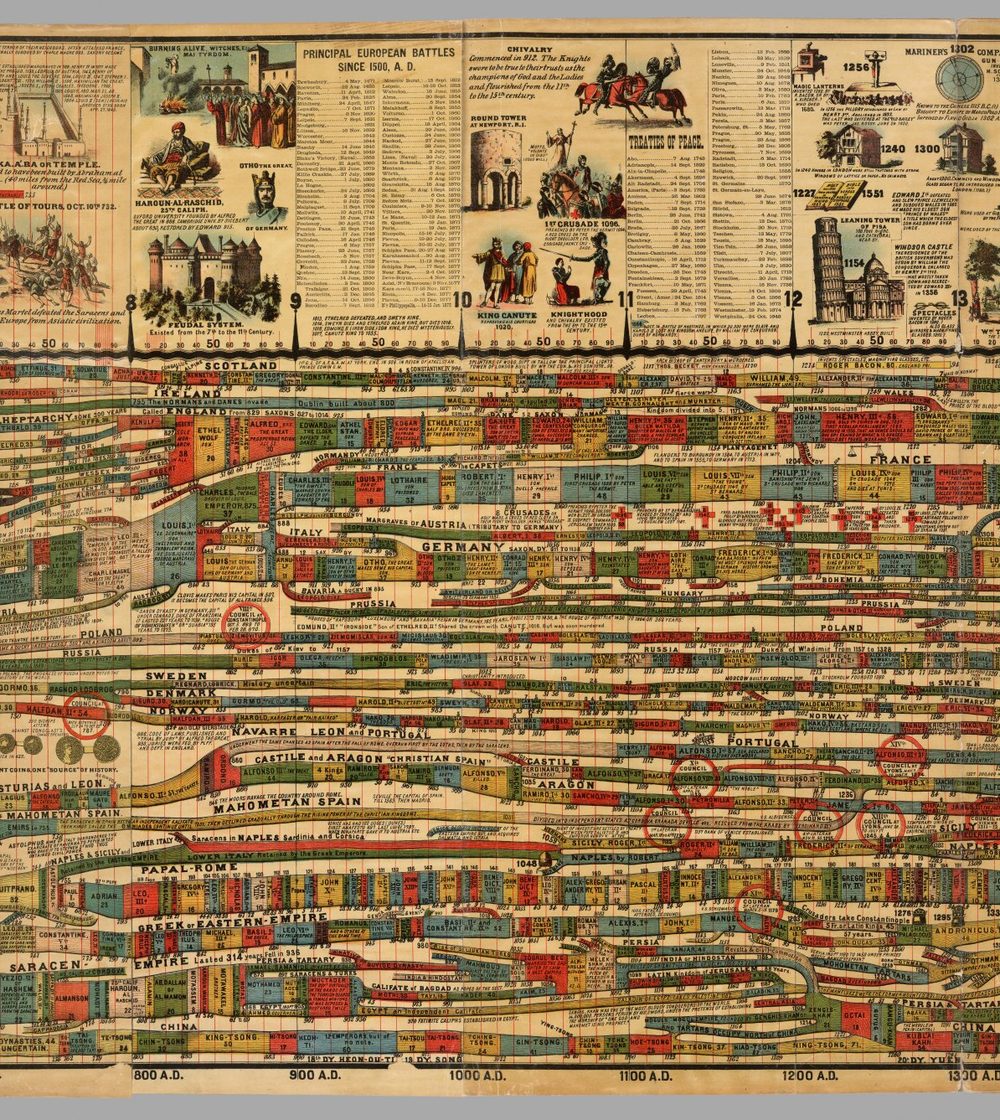
Panel 9 of Sebastian C. Adams' Synchronological Chart covers roughly AD 700 to 1300. It opens with the Battle of Tours, which Adams dates to October 10, 732, and it carries the story through Charlemagne, Alfred the Great, the Normans, the Crusades and the founding of the Mogul Empire. As everywhere on the chart, these histories run side by side, so that England, France, Spain, Russia, Persia and China can be read in the same years.
Charles Martel and Charlemagne
The panel begins with Charles Martel, who defeated the Saracens at Tours. After him come Pepin and Pepin's son Charlemagne, "Charles the Great," whom Adams records as crowned Emperor of the West by Leo III in 800, the year that Haydn's Dictionary of Dates also gives. In the same years the chart names Haroun-al-Raschid, whom Adams lists as the 25th caliph.
In Spain, Adams follows "Mahometan Spain" and, alongside it, the kingdom of Asturias and Leon, where he names Pelagius. The chart also names Otho the Great of Germany and Hugh Capet of France.
England from Egbert to Magna Charta
In England, Adams records that "the Normans and Danes invade," and he follows the Saxon kings from Egbert to Alfred the Great. He notes that Alfred was the first king in England to be anointed, and he credits him with a code of laws and "trial by jury." The Danish kings follow, and Canute becomes king in 1017.
Then comes the Battle of Hastings, and with it the Norman line, which Adams dates from 1066. He adds that Windsor Castle, "the residence of the British sovereigns," was begun by William the Conqueror. Later entries record Magna Charta, granted in 1215, and Edward I, who "defeated and slew Prince Llewellyn and subdued Wales in 1282."
The Crusades
Adams explains that the Crusades took their name from the cross of red cloth that the crusaders wore. He dates the First Crusade to 1096, names Peter the Hermit, who preached it, and Godfrey, who led it, and records "Jerusalem taken 1099."
The Second Crusade, preached by St. Bernard, ends in defeat. Saladin of Egypt takes Palestine in 1187, the year Haydn gives for the loss of Jerusalem. Adams calls the Third Crusade, under Frederick Barbarossa, Philip II and Richard I, "glorious but fruitless." Later still, "Crusaders take Constantinople," and Louis IX of France is defeated and taken prisoner.
Caliphs, Turks and Moguls
Farther east, the chart follows the Califate of Bagdad, the Fatimite caliphs and the Seljukian Turks. In Russia, Adams names Rurik, "a Varangian chief," who established the first government in 862, the same year that Haydn gives, and after him Igor and Wladimir. The Mogul Empire is founded by Genghis Khan, the chart records "Bagdad overthrown," and before the panel ends it names Othman.
Daily Life and Invention
Adams also notes how people lived. Houses in London, he writes, were still thatched with straw, with "windows of lattice or paper." He credits Roger Bacon of England with spectacles and magnifying glasses. Other entries include the Leaning Tower of Pisa, which Adams dates to 1154, as Haydn does, and the mariner's compass. The world of the knights has its place too, in entries headed "Chivalry," "Knighthood" and "Feudal System."
Explore Panel 9
Open the panel in the interactive chart to read these entries in Adams' own words. Search for "Crusade," "Alfred," "Saladin" or "Genghis" to jump straight to them.