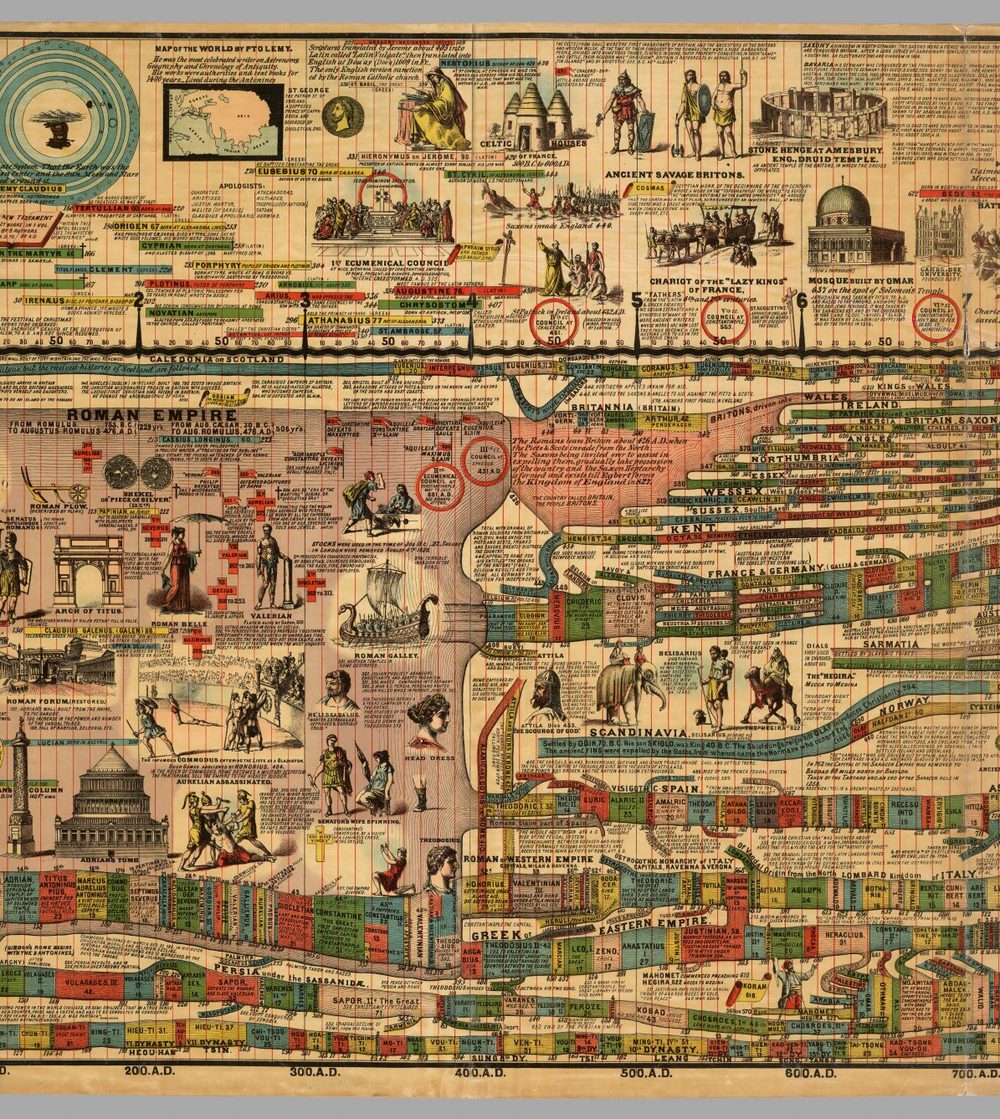
Panel 8 of Sebastian C. Adams' Synchronological Chart covers roughly AD 100 to 700. It opens in the age of Trajan and Hadrian and closes in the decades after the Hegira of Mahomet. Between those two moments, the chart follows the Roman Empire as it divides and as its western half comes to an end, the growth of the early church, the coming of the Saxons to Britain and the rise of new powers in Arabia and Persia.
Rome from Trajan to Constantine
The panel begins with Trajan and an illustration of his monument at Rome. Hadrian follows, with an illustration of his tomb, and then Antoninus Pius and Marcus Aurelius. Of the next emperor, one entry shows "the infamous Commodus entering the lists as a gladiator."
Later emperors include Severus, Valerian, Aurelian and Diocletian. After them comes Constantine. Adams records that he "removes the capital to Byzantium called Constantinople." He also records the first ecumenical council, held at Nice in Bithynia and called by Constantine, which he dates to AD 325, as Haydn's Dictionary of Dates does. Adams notes that 318 bishops were present and that the "Nicene Creed" was formed there.
The Empire Divided
The chart names Theodosius, under whom, as Adams' Key explains, the Roman Empire was divided. A short entry reads "The Empire divided." Adams now follows two empires, the "Roman or Western Empire" and the "Greek or Eastern Empire." Rome itself is captured by Alaric, which Adams dates to 410, and Attila, "the Scourge of God," dies in 453. The two dates agree with Haydn. Adams ends the western empire in 476, the year Haydn gives for the end of the Roman empire in Italy.
In the east, the chart names Justinian and his law code, the general Belisarius and, later, Heraclius. In the west, new kingdoms take the place of Rome: the Ostrogothic monarchy of Italy, the Lombards, Visigothic Spain and the kingdom of Clovis. Adams marks the rise of the French feudal system in 486, the year Haydn gives for the feudal laws that Clovis established in France. An illustration shows the "Chariot of the 'Lazy Kings' of France."
The Early Church
Adams lists the Apologists, among them Justin the Martyr, and names Polycarp and Irenaeus. Origen, Tertullian and Cyprian follow, then Eusebius, Athanasius, Jerome, Chrysostom and Augustine. The chart marks the council at Ephesus in 431, the year Haydn gives for the condemnation of Nestorius there.
The chart also shows a "Map of the World by Ptolemy" and explains the Ptolemaic system, in which the sun, moon and stars "revolved around" the Earth.
Britain and Ireland
Adams draws Stonehenge, which he spells "Stone Henge," and calls it "an ancient temple of the Britons in which the Druids officiated," a description that follows Haydn's Dictionary of Dates almost word for word. He records Lucius as the "first Christian king" in Britain. Later the Romans leave Britain, and "The Picts & Scots invade from the North." The Saxons, invited over to help drive them out, "gradually take possession of the country." The chart names the kingdoms of the Saxon Heptarchy: Kent, Sussex, Essex, Wessex, East Anglia, Mercia and Northumbria. In Ireland, Adams places St. Patrick about 432. The English monk and historian Bede also appears.
Arabia and Persia
Adams names Mahomet and the Koran and records the Hegira in 622, the year Haydn also gives. He notes the mosque built by Omar in 637 on the site of Solomon's Temple, a date that again agrees with Haydn. Persia appears with kings such as Sapor II and Chosroes. Farther east, the chart follows the Later Han dynasty.
Explore Panel 8
Open the panel in the interactive chart to read these entries in Adams' own words. Search for "Commodus," "Hegira," "Attila" or "Stone Henge" to jump straight to them.