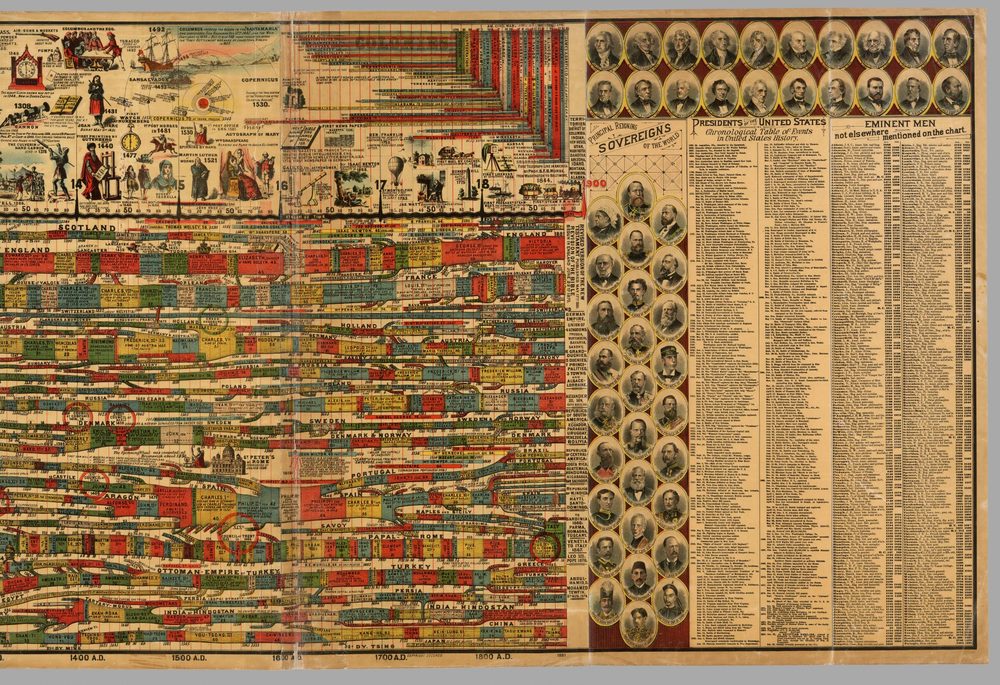
Panel 10 of Sebastian C. Adams' Synchronological Chart covers roughly AD 1300 to 1878. It is the last panel of the chart and one of the most crowded. It opens with the fourteenth and fifteenth centuries, the age of William Tell and Joan of Arc, and runs through the voyages of discovery, the rise of modern science and the revolutions in America and France, down to the century in which Adams himself lived. Alongside the nations of Europe, the chart now gives a large share of its space to the United States.
Discoveries and inventions
Adams fills the panel with the tools and discoveries that changed the age. He credits the mariner's compass to Flavio Gioja in 1302, the year that Haydn's Dictionary of Dates also gives. He records the first printing by Gutenberg, and he follows Columbus to the discovery of America in 1492, with a small scene titled "Columbus and the Egg."
The new astronomy has its place too. Copernicus is dated 1530, as in Haydn, and Galileo appears as the astronomer who improved the telescope. Isaac Newton follows with the discovery of gravity.
Later inventions come one after another. Adams notes that Montgolfier raised the first balloon at Annonay, in France, on June 5, 1783, the same day that Haydn gives. He records Fulton's Clermont, the first passenger steamboat, on the Hudson River, and the first telegraph line in America, built by Professor S. F. B. Morse from Washington to Baltimore.
Europe from Joan of Arc to Napoleon
In France, the chart records the siege of Orleans raised by Joan of Arc in 1429, and her death: she was burnt on May 30, 1431, the date that Haydn also gives. It also shows Martin Luther at Worms in 1521.
In his Key to the chart, Adams chose the sixteenth century to show how much a single century holds. His list includes Copernicus, Columbus and Luther, along with Erasmus, John Knox, Shakespeare, Cardinal Wolsey, Raphael and Galileo, and every one of them can be found on this panel. Shakespeare even appears in a small scene, "reading his plays to Queen Elizabeth."
Two centuries later, the chart records that Louis XVI of France was guillotined in 1793. The story of Napoleon ends with the Battle of Waterloo, which Adams dates to June 18, 1815, and with Napoleon banished to St. Helena.
The United States
For the United States, Adams adds a "Chronological Table of Events in United States History." Its entries include the founding of Jamestown, Virginia, by the English, the landing of the Pilgrims at Plymouth Rock in 1620, the line "July 4, Declaration of Independence" and the adoption of the Constitution on September 17, 1787.
The Civil War is recorded in close detail, battle by battle, with short entries such as "July 1-3, Gettysburg, Pa., Meade vs. Lee" and "July 4, Vicksburg, Miss., surrendered to Grant."
The panel also carries a gallery of portraits headed "Presidents of the United States," from George Washington to James A. Garfield. A companion set, "Principal Reigning Sovereigns of the World," shows the rulers of Adams' own day, among them Queen Victoria, Alexander II of Russia and Pope Leo XIII.
Eminent men
A last list gathers "Eminent Men not elsewhere mentioned on the chart": writers, scientists and statesmen, most of them with a few words of description. One of them is the fourteenth-century writer Adams describes as "Boccaccio, Italian novelist."
Explore Panel 10
Open the panel in the interactive chart to read these entries in Adams' own words. Search for "Columbus," "Joan of Arc," "Montgolfier" or "Gettysburg" to jump straight to them.