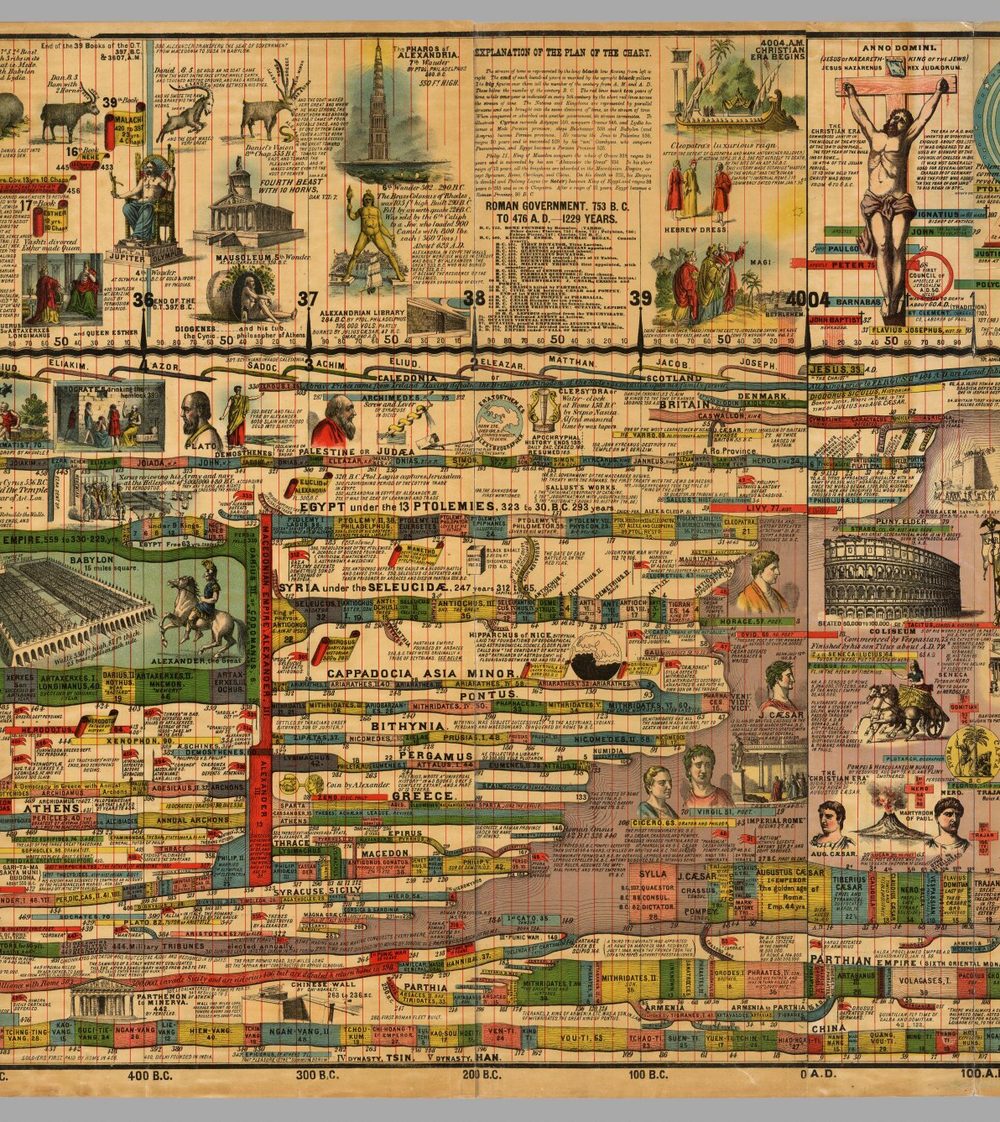
Panel 7 of Sebastian C. Adams' Synchronological Chart covers roughly 500 BC to AD 100. It is the panel on which the chart's count of years turns, at the entries Adams heads "Christian Era Begins" and "Anno Domini." Around that turning point he sets six centuries of history: the Persian kings and the last books of the Old Testament, the great age of Athens, the conquests of Alexander, the kingdoms of his successors, and the rise of Rome from republic to empire.
Persia and Jerusalem
The panel opens in the age of the Persian kings, with names such as Xerxes and Ahasuerus. The story of Esther appears in brief entries, among them "Vashti divorced." Adams records that Ezra went up to Jerusalem in 458 BC, the year that Haydn's Dictionary of Dates gives for Ezra's arrival there, and he names Nehemiah as well. A short line then marks the end of the books of the Old Testament.
Greece at Its Height
Across the same years, the chart follows Athens, Sparta and Thebes. Thermopylae and its defender Leonidas appear, with the Greek victory over the Persians at the Eurymedon.
The Athens of Pericles is also the age of the historian Herodotus and the dramatist Sophocles. Then come the philosophers: Socrates, Plato, whom the chart calls the "tutor of Aristotle," and Diogenes. One entry reads "Socrates drinking the hemlock," dated 399 BC, the year Haydn gives for the death of Socrates.
Alexander and His Successors
Alexander the Great follows. Adams records the battle of the Granicus and the entry "Alexander defeats Darius." After Alexander, the chart follows the kingdoms of his successors: Seleucus in Syria, and Egypt under the Ptolemies, with a note on "the golden age of the Ptolemies." Scholars of the age appear too, among them Euclid, Archimedes and Eratosthenes.
Among the Seven Wonders of the World, Adams marks the Mausoleum as the "5th Wonder" and the Pharos of Alexandria, which he credits to Ptolemy Philadelphus, as the "7th Wonder." The Brass Colossus of Rhodes "fell by an earth quake 224 B.C.," the year Haydn also gives.
Rome, from Republic to Empire
Rome enters the panel as the Republic of Rome. The chart follows its wars with Carthage and Hannibal. Then come the First Triumvirate of Julius Caesar, Pompey and Crassus, Caesar's first invasion of Britain, and his famous "Veni! Vidi! Vici!"
Adams gives "Cleopatra's luxurious reign" its own entry, and he dates the battle of Actium, where Octavius defeated Mark Antony, to 31 BC, as Haydn does. Octavius becomes Augustus Caesar, and the chart speaks of "The golden age of Rome."
The Christian Era
Adams notes that the Christian era begins in the reign of Augustus Caesar. The chart names Bethlehem and the Magi, John the Baptist and Pontius Pilate, and it names Jesus of Nazareth with the title "The Christ." An entry adds: "It is now held that Christ was born from 4 to 6 B.C." The first Christian generations appear through names such as Barnabas and Ignatius, "Bishop of Antioch," and through the entry "Martyrdom of Paul."
Rome under the Emperors
The chart names the emperors Caligula, Nero and Vespasian. Adams marks the first persecution of the Christians under Nero, and he describes Seneca as "tutor of Nero, put to death by Nero." Vespasian's son Titus takes Jerusalem in AD 70, and the Coliseum is "finished by his son Titus." In AD 79 Pompeii and Herculaneum are buried by Vesuvius, in an entry that ends "and Pliny smothered."
Beyond Rome
The chart keeps other peoples in view as well: the Parthian Empire; Britain, where it names Cymbeline and Caractacus; and China, with an entry on the "Chinese Wall."
Explore Panel 7
Open the panel in the interactive chart to read these entries in Adams' own words. Search for "Thermopylae," "Ptolemies," "Actium" or "Bethlehem" to jump straight to them.