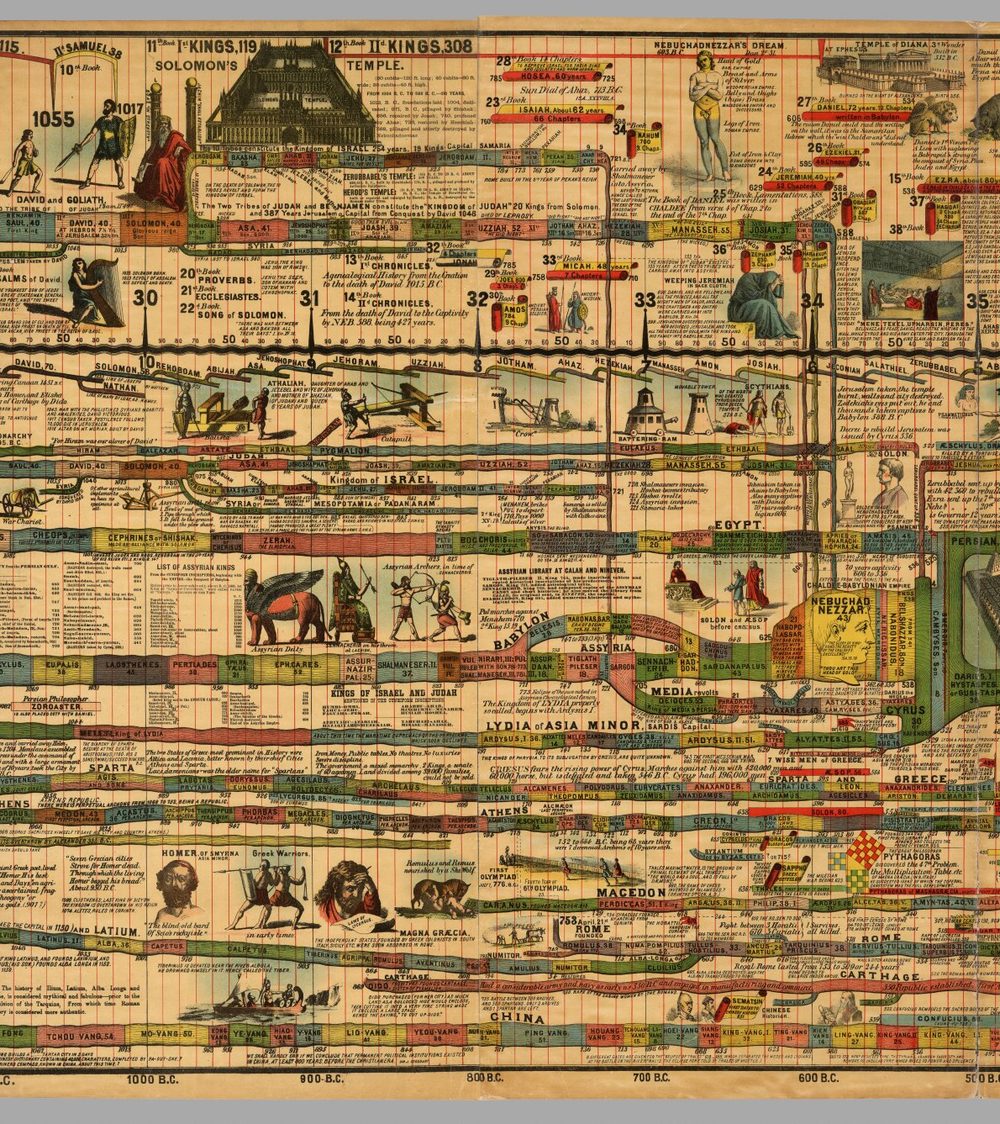
Panel 6 of Sebastian C. Adams' Synchronological Chart covers roughly 1100 to 500 BC. It opens with Saul, the first king of Israel, whose reign Adams begins in 1095 BC. It closes in the age of Cyrus of Persia. Between the two, the chart follows the kingdoms of Israel and Judah, the empires of Assyria and Babylon, the lawgivers of Greece and the first kings of Rome, all running side by side.
Saul, David and Solomon
After Saul come David and Solomon. The chart includes "David and Goliath" and lists the Psalms of David, and for Solomon it names Proverbs, Ecclesiastes and the Song of Solomon. The Temple that Solomon built has its place on the panel.
Two Kingdoms
Then the kingdom divides. In Adams' words: "On the death of Solomon, the 10 tribes revolt and form the Kingdom of Israel." Rehoboam keeps Judah and Benjamin, and Jeroboam rules the new kingdom of Israel.
From here the chart carries two lines of rulers, which it labels "Kings of Israel and Judah." In Israel come Omri, Ahab and his queen Jezebel, and Jehu; in Judah, Asa, Athaliah, Joash, Uzziah, Ahaz, Hezekiah and Manasseh. The prophets appear with them, among them Isaiah, Jeremiah, Ezekiel, Daniel and Nahum. One small entry records the "Sun Dial of Ahaz, 713 B.C."
The kingdom of Israel ends first. The chart marks "728 Shalmaneser's invasion" and "721 Samaria taken," and the ten tribes are carried away into Assyria.
Exile and Return
Judah lasts longer. Adams dates the capture of Jerusalem by Nebuchadnezzar of Babylon, and the burning of the Temple, to 588 BC, and he records that thousands were taken captive to Babylon. The panel also shows "Nebuchadnezzar's Dream" from the Book of Daniel, the great image labeled part by part, from "Head of Gold" to "Feet of Iron & Clay."
The chart then records Belshazzar's feast and the fall of Babylon to Cyrus. Adams dates the decree of Cyrus to rebuild Jerusalem to 536 BC, and the panel goes on to name Zerubbabel and Ezra.
Assyria, Media and Persia
The chart names Assyrian kings such as Sennacherib and Sardanapalus, pictures "Assyrian Archers, in time of Sennacherib," a battering ram and a war chariot, and notes an "Assyrian Library at Calah and Nineveh." In Babylon it names Nabonassar and Nabopolassar. The chart records that "Media revolts," and names Cyaxares among the Median kings. Then come Cyrus and the Medo-Persian Empire, and after him Cambyses, under whom Egypt becomes a Persian province in 525 BC. Zoroaster is here as well, labeled "Persian Philosopher."
Greece
In Greece, the chart records the "Laws of Lycurgus" and sums up life in Sparta: "Iron Money. Public tables. No theatres. No luxuries." Homer appears with the line "The blind old bard of Scio's rocky isle." Later come Solon, one of the seven wise men of Greece, the fable writer Aesop, and Pythagoras, credited with "the Multiplication Table."
Rome, Carthage and China
Rome is founded on this panel. Adams dates its founding to 753 BC and pictures "Romulus and Remus, nourished by a She Wolf." The kings who follow include Numa Pompilius, Ancus Martius and Servius Tullius. The chart records the first census of Rome in 566 BC and the first money coined at Rome. Adams adds a caution: the early history of Rome "is considered mythical and fabulous" until the expulsion of the Tarquins.
Across the sea, Dido comes from Tyre and founds Carthage. Far to the east, the chart follows the kings of China and, in the sixth century BC, names Confucius.
Explore Panel 6
Open the panel in the interactive chart to read these entries in Adams' own words. Search for "Solomon," "Samaria," "Nebuchadnezzar" or "Romulus" to jump straight to them.