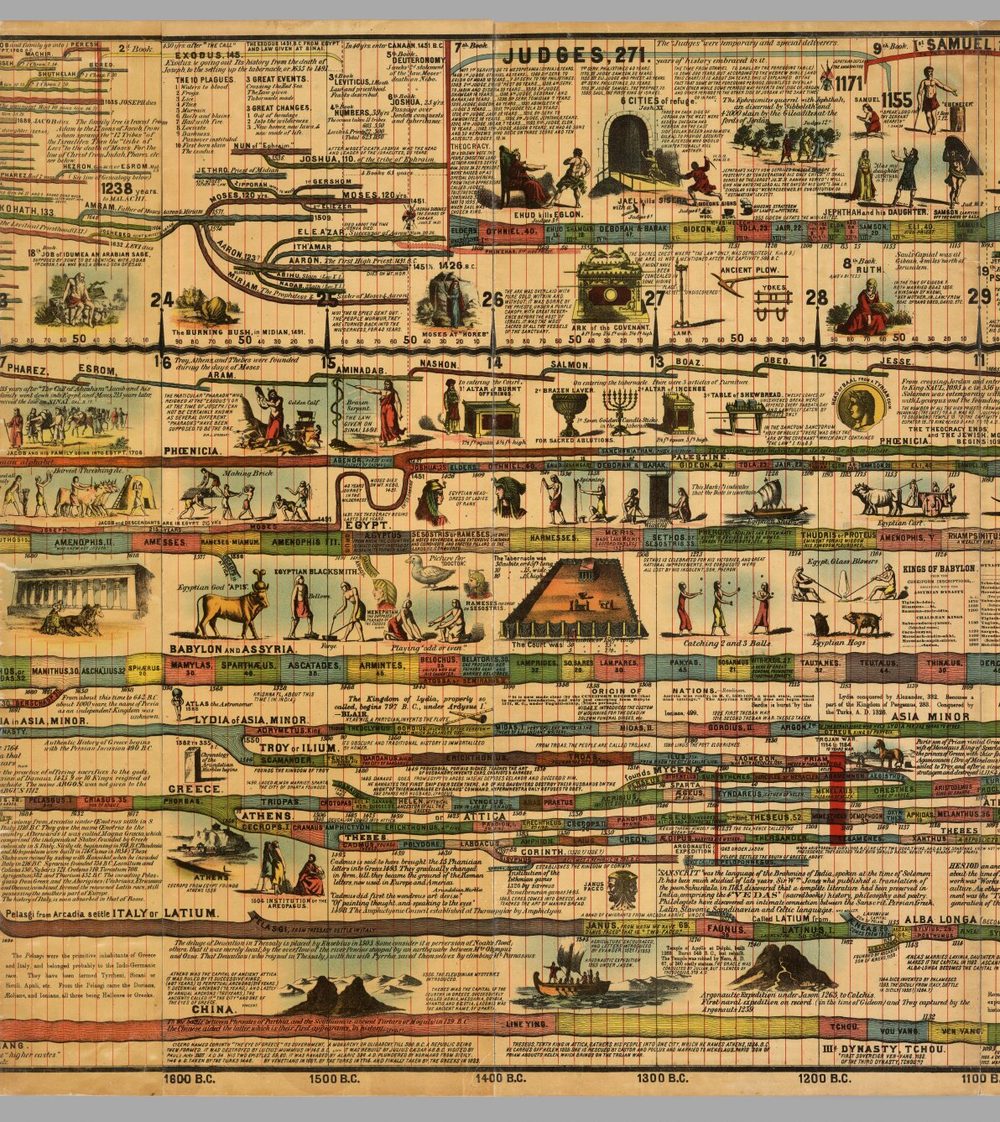
Panel 5 of Sebastian C. Adams' Synchronological Chart covers roughly 1700 to 1100 BC. It opens with a family on the move, as Jacob and his household go down into Egypt, which Adams dates to 1706 BC. It closes with a people asking for a king. Between those two moments come the Exodus, the giving of the Law and the long age of the Judges. And because this is a synchronological chart, all of it runs alongside the early histories of Egypt, Greece, Troy, Italy and China.
Israel in Egypt and the Exodus
Adams follows the family of Jacob in Egypt through the death of Jacob, which he places in 1689 BC.
The great event of the panel is the Exodus, which Adams dates, following Archbishop James Ussher, to 1491 BC. The chart gathers its episodes one after another: the burning bush in Midian, Jethro the priest of Midian, the ten plagues, the crossing of the Red Sea and the giving of the Law. Adams records that Aaron became "the first High Priest" in the same year. The making of the Tabernacle, the Ark of the Covenant and the table of shewbread follow, and the story of Moses ends with his death on Mount Nebo.
Joshua and the Judges
After Moses comes Joshua, and after Joshua the Judges. Adams sums up their role in a single line: "The Judges were temporary and special deliverers." The chart names them in turn, among them Othniel, Ehud, Deborah and Barak, Gideon, Jephthah, Eli and Samuel. Some of the most dramatic episodes of the Book of Judges appear as short entries: "Ehud kills Eglon," "Jael kills Sisera," "Jephthah and his daughter."
The Book of Ruth has its place here too. Ruth and Boaz, and after them Obed and Jesse, continue the family line into the next panel.
The panel ends at a turning point. Adams marks the end of the theocracy and the beginning of the Jewish monarchy in 1095 BC, the year that Ussher gives for Saul becoming king.
Egypt
Across the same centuries, the chart follows the kings of Egypt, among them Amenophis II, Amenophis III and the pharaoh Adams names "Sesostris or Rameses." It also records the crafts of the age, with entries such as "Making Brick," "Egyptian Blacksmith," "Egypt Glass Blowers" and "Ancient Plow."
Greece, Troy and Italy
This is also the age in which Adams begins the history of Greece. He names its early cities, Athens, Thebes, Corinth, Sparta and Mycenae, and figures such as Cecrops, who in his account came from Egypt to found Athens. Troy, or Ilium, appears with the founding of its kingdom. The chart also records the Argonautic Expedition under Jason to Colchis, which it dates to 1263 BC, the same date that Haydn's Dictionary of Dates gives.
Farther west, Adams notes that the Pelasgi from Arcadia settle Italy, or Latium, and he follows the story of Latium to Alba Longa, the city that becomes its capital.
Beyond the Mediterranean
The chart keeps other peoples in view as well: Phoenicia, Babylon and Assyria, Lydia and Asia Minor, and China. Of India, Adams writes: "'SANSCRIT' was the language of the Brahmins of India, spoken at the time of Solomon."
Explore Panel 5
Open the panel in the interactive chart to read these entries in Adams' own words. Search for "Exodus," "Judges," "Argonautic" or "Cecrops" to jump straight to them.