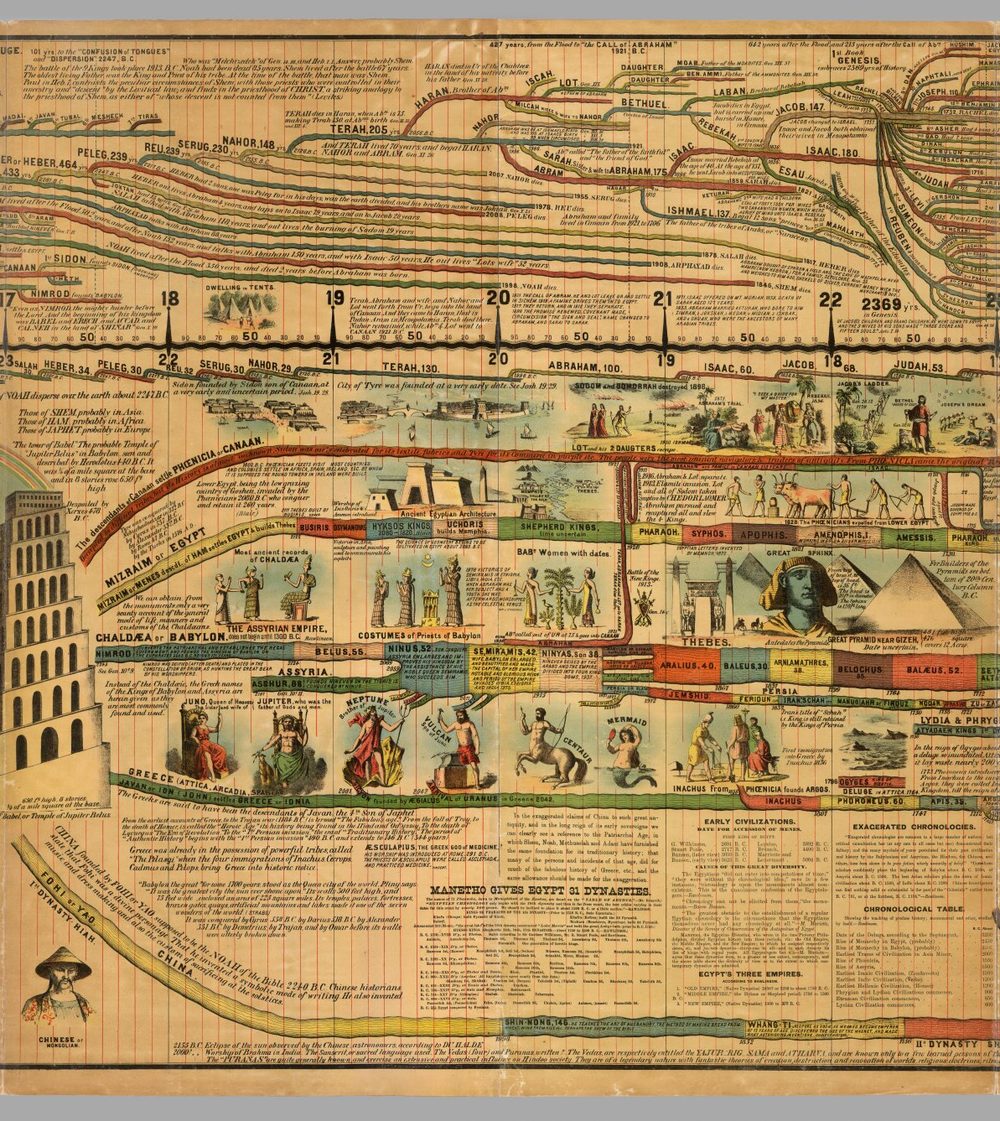
Panel 4 of Sebastian C. Adams' Synchronological Chart covers roughly 2300 to 1700 BC. It opens with the dispersion of the nations and closes with Joseph sold into Egypt. In between comes the age of the patriarchs Abraham, Isaac and Jacob. And because this is a synchronological chart, their story runs alongside the first kingdoms of Egypt, Babylon and Assyria, and the earliest traditions of Greece and China.
The dispersion of the nations
Adams dates the confusion of tongues and the dispersion to 2247 BC, the same year that Archbishop James Ussher and Haydn's Dictionary of Dates give for the Tower of Babel. He identifies the tower with the "Temple of Jupiter Belus" in Babylon. The descendants of Noah's three sons then go their separate ways, and the chart sums up the result in three short lines: "Those of Shem, probably in Asia. Those of Ham, probably in Africa. Those of Japhet, probably in Europe."
The chart makes Nimrod the founder of Babylon, and records that Mizraim, a descendant of Ham, settles Egypt. Of the Greeks, Adams writes that they "are said to have been the descendants of Javan." The line of Shem continues through Heber, Peleg, Serug, Nahor and Terah to Abraham.
Abraham, Isaac and Jacob
The family of Abraham is the thread that runs through the whole panel. Adams dates the call of Abraham to 1921 BC, following Ussher. The chart then follows Abraham and Lot into Canaan, the story of Hagar and Ishmael, and the destruction of Sodom and Gomorrah, which it dates to 1898 BC, the same year that Haydn gives. Lot and his two daughters escape, and the chart traces two peoples back to this family, the Moabites and the Ammonites.
After that come Abraham's trial, when Isaac is offered, and the death of Sarah, for whom Abraham buys the cave of Machpelah near Hebron. Rebekah enters the story with a short line: "I seek a bride for my master." Adams adds that "Isaac and Jacob both obtained their wives in Mesopotamia."
The story of Jacob follows: Esau and Jacob, Jacob's ladder at Bethel, the "House of God," then Leah and Rachel and the sons of Jacob, among them Reuben, Simeon, Levi, Judah, Joseph and Benjamin. The panel ends with Joseph's dream and Joseph sold into Egypt.
Egypt
Adams divides the history of Egypt into "Egypt's Three Empires" and notes that "Manetho gives Egypt 31 dynasties." He names the Hyksos, or Shepherd Kings, and pharaohs such as Apophis and Amessis. The Great Pyramid near Gizeh and the Great Sphinx appear here as well, with a plain note on the pyramid: "Date uncertain."
Babylon, Assyria and Greece
The chart shows the "Costumes of Priests of Babylon," and for Assyria it names the early rulers Belus, Ninus and Semiramis. In Greece it names Inachus, who in Adams' account came from Phoenicia to found Argos, and Phoroneus. Adams also records a deluge in Attica in the reign of Ogyges, which he dates to 1764 BC, the same date that Haydn gives.
Persia, India and China
Persia, India, Lydia and Phrygia, and China all have their place on the panel. The chart names Fohi for China.
Exaggerated chronologies
This panel also looks at the writing of history itself. A table headed "Exaggerated Chronologies" sets the very long histories claimed by several ancient nations against more modest dates, "According to Rawlinson." It lists the rise of Assyria and of Phoenicia, the earliest Indic civilization of the Vedas, the earliest Iranic civilization of the Zendavesta, and the beginnings of Etruscan and Lycian civilization.
Explore Panel 4
Open the panel in the interactive chart to read these entries in Adams' own words. Search for "Abraham," "Sodom," "Pyramid" or "Babel" to jump straight to them.